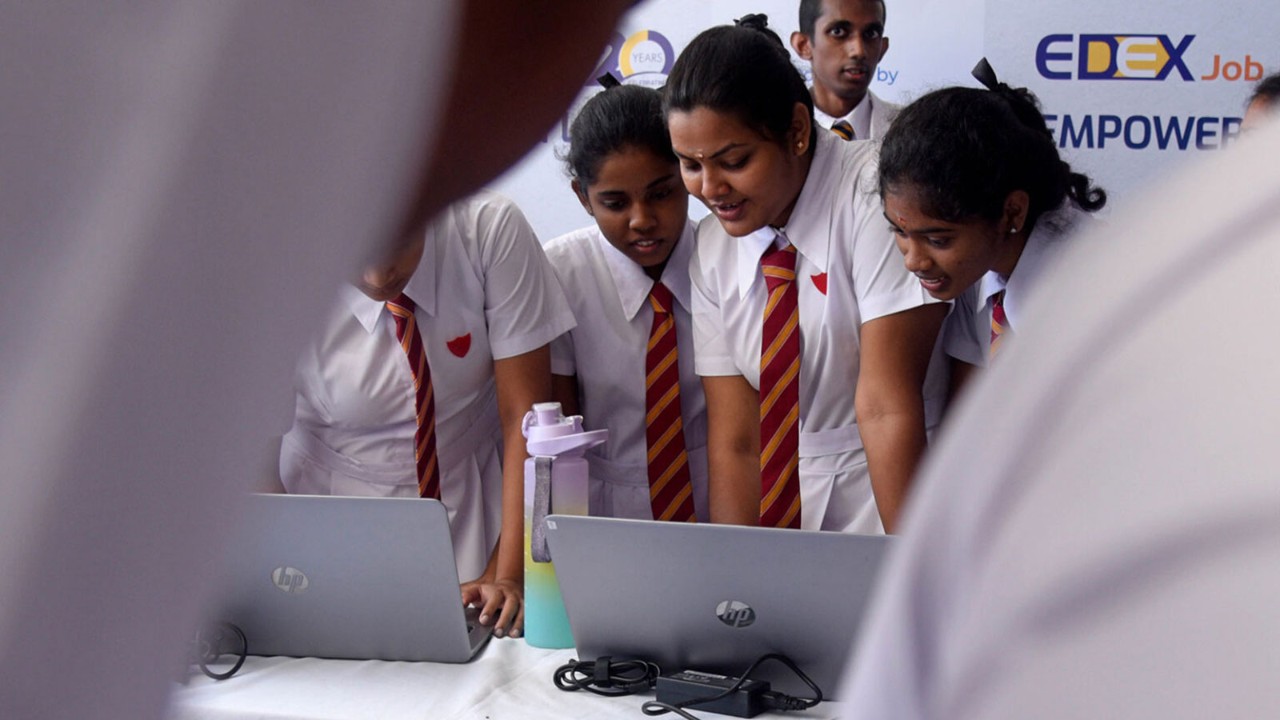

AI is transforming working practices around the world. Sri Lanka, however, appears to be caught between old habits and a future it has yet to fully prepare for.
The World Bank’s latest South Asia Development Update shows that the country has one of the region’s highest exposures to AI-driven change, thanks to its relatively educated workforce and service-oriented structure. But this is not enough to translate into readiness.
The World Bank notes that jobs combining human reasoning with technology tend to thrive, while those with routine digital inputs decline.
Commitment varies across sectors, with banking, logistics and professional services already changing their hiring models. People’s Bank, for example, has launched a trilingual AI-powered website chatbot, handling customer queries once managed by call-centre staff. Commercial Bank has gone further, introducing an AI-driven assistant enabling investors and analysts to search its annual report by voice or keyword.
Sri Lanka’s education system is struggling to keep pace with this change
Playing catch up
At the same time, Sri Lanka’s education system is struggling to keep pace with this change. Public spending on research and development remains among the lowest in Asia, and coordination between industry and academia is lacking.
Specialist organisations have made some headway in filling the gap. The Sri Lanka Association for Software and Services Companies recently rolled out a training programme designed to equip IT professionals with the skills needed to become effective future leaders, while the University of Moratuwa and the Sri Lanka Institute of Information Technology have introduced data science and AI courses.
Automation can expand opportunity if policy focuses on inclusion
This year the government unveiled its national AI Strategy, which aims to reduce the knowledge gap through coordinated investment in data skills, and infrastructure. The strategy aims to create a National Centre for Artificial Intelligence and build AI literacy across schools, universities and the civil service.
While the government’s digital programmes have improved basic services, large-scale modernisation is uneven, as power instability, weak internet outside major cities and patchy cloud capacity make advanced AI applications costly and harder to deploy. This volatility was highlighted during the blackouts of the 2022 economic crisis, when many IT companies were forced to invest in private generators and backup internet.
Positive outlook?
The World Bank estimates that South Asia’s total factor productivity remains two-thirds of the average for other emerging economies. Across South Asia, jobs requiring AI expertise now earn about 30% higher wages, led by India and Sri Lanka. Highly skilled professionals in software, analytics and finance are now in a position to command regional wages, while those in clerical, administrative or manual roles see few gains.
Automation can expand opportunity if policy focuses on inclusion rather than protection. The country’s tax incentives for IT services and digital startups are steps in that direction, but retraining and social mobility programmes continue to be small.
Economies that have adapted to AI share a few common traits such as flexible labour systems
Business groups and public agencies such as the Information Communication Technology Agency of Sri Lanka are promoting pilot programmes and skills bootcamps, yet firm-level adoption still skews towards larger banks and IT services, with smaller firms citing cost and expertise as barriers. Even where systems are available, managers often hesitate to trust machine-generated recommendations, as Sri Lanka still predominantly values stability over innovation.
Globally, economies that have adapted to AI share a few common traits such as flexible labour systems, sound infrastructure and lifelong learning.
Sri Lankan businesses and individuals need to understand that AI will not erase jobs; in fact, it will change where value is created and who benefits from it. In the coming decade we will be tested on whether the country can channel its technical base into productivity. The answer will define whether Sri Lanka will be among the countries that lead the way in AI adoption.


