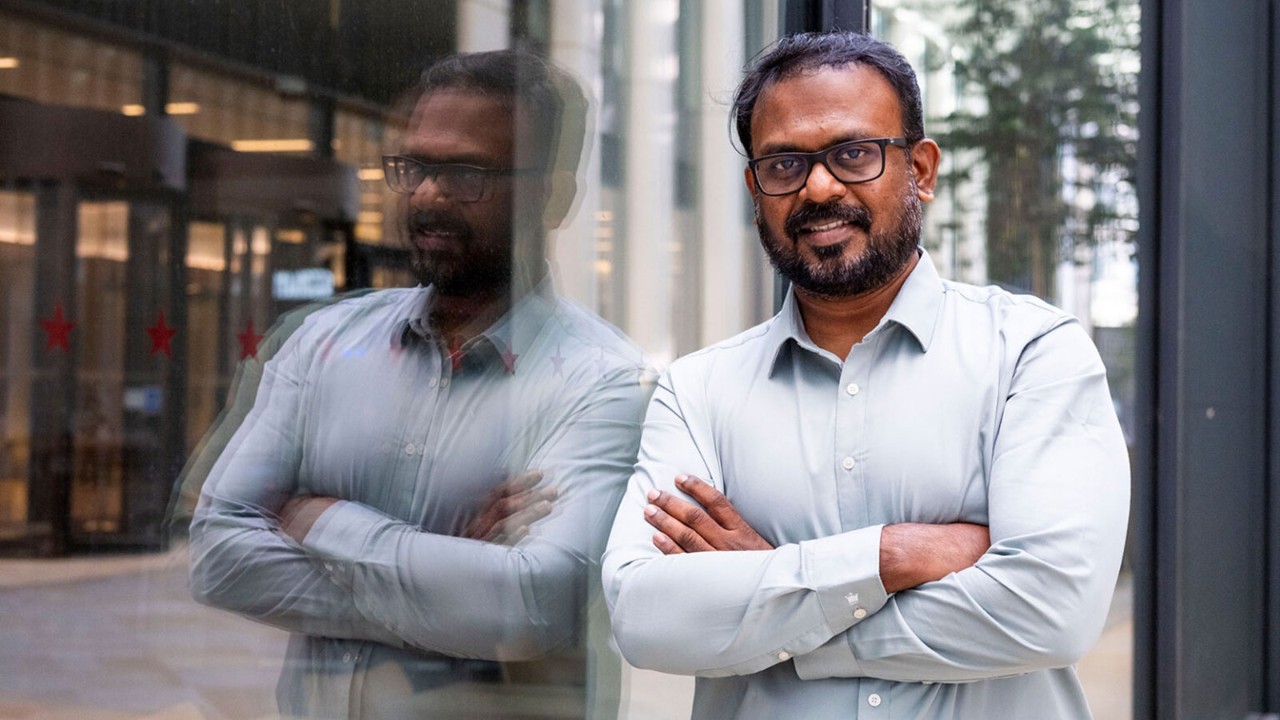
For Naresh Kumar, head of digital commercial and open innovation at Shell, one of the world’s largest oil and gas companies, his tech journey began when he ‘started writing code to see how we can see finance differently’.
‘I constantly asked myself whether an activity truly added value to the company, or if I could automate, transform or solve it through technology to deliver greater efficiency and impact,’ he says.
‘Since the early 2000s, I’ve built a multidisciplinary career at the intersection of finance, digital innovation, transformation and design thinking. Recognised as the finance and tech leader within organisations, I’ve consistently positioned myself as the bridge between business strategy and technology, driving transformation, automation and measurable value creation,’ he says.
‘Only through innovation can you prove growth and move upward’
In 2011, Naresh attended the Dreamforce conference hosted by Salesforce in San Francisco, eager to explore how cloud computing could help solve business and financial challenges. The event exposed him to ideas that were far ahead of what the finance world was doing at the time, sparking a shift in his thinking.
Inspired by the possibilities, he began experimenting with design-thinking approaches to reimagine financial analysis and reporting. This led to deeper exploration of cloud-based solutions for streamlining finance operations. Over time, his curiosity expanded into emerging technologies such as natural language processing and intelligent agents, and eventually culminated in a series of papers on how these innovations could transform the finance function.
Based in Bengaluru in India, his integrative approach now shapes the way he leads Shell’s commercial and open source strategy for emerging technologies, including the use of artificial intelligence and blockchain to redefine corporate treasury. He has noticed a clear innovation gap, as most solution providers ‘embrace technology as one solution instead of solving the problem for businesses’. Finance, he says, is ‘very sensitive’, and corporations ‘want to know exactly what can solve the problem and pain areas’.
Crucial partnerships
In a dynamic tech landscape, ‘the organisation has to be on top of things’, he adds. Co-innovation with strategic suppliers, tech companies and startups is vital. ‘Accessing top talent outside the industry, innovating for value and outside-in digital capability building also help reduce costs in development and deployment.’
Open innovation between big companies, he says, solves ‘problems of cross-border transactions and automating treasury, reduces cost and improves working capital for both companies’. He is an enthusiast for open-source communities and is a governing board member of Linux Foundation Energy. ‘Because it is open source, you can fork it, use it, enhance, contribute and consume the products.’
The bigger question, though, is how to build trust in such ecosystems. One way is ‘time-tested partnerships’, Naresh says. ‘We understand the credibility of the founders and the startup’s ability to solve problems through hackathons,’ he explains. The process involves ‘cooperating, competing with each other, and performing multiple screening tests before onboarding them’.
‘Stablecoin accelerates cross-border transactions and reduces cost’
Navigating roadblocks
Driving open innovation in finance comes with challenges, with many large companies experiencing an ‘innovation trilemma’ of capital, capability or cultural deficit. To address these challenges, Naresh says businesses need dedicated innovation funding and a focus on ‘innovation accounting’. Instead of ‘blocking a million dollars for a project throughout the year without knowing whether it will be successful, we can do meter funding with a few ideas and contribute to the initial stage’, he suggests. Once the project moves on from idea to product, ‘you can fuel money into that’. He adds that robust governance and leveraging of existing strategic partnerships and incentives are necessary to tackle challenges.
In 2022, Naresh was part of the decentralised finance talents programme at the Frankfurt School Blockchain Center. He says that a stablecoin is a ‘currency which you can float across the world’ to accelerate cross-border transactions, reduce cost and ‘mobilise the funds as quickly as possible’. But there are hurdles corporates face here, such as ‘restriction towards regulatory compliance in various jurisdictions, and accounting and reporting ambiguity, with no universal accepted accounting treatment for recognising stablecoin on the balance sheet’.
It has to ‘evolve and come all together’, he says, as larger organisations such as Shell operate across scores of countries and have to focus on the entire landscape.
Value shift
For an organisation, it is only ‘through innovation that you can prove your growth and move upward’, he says. The core of innovation is identifying the gap between where you want to be as an organisation and your current capability.
‘Embrace the project-to-product mindset’
Embracing a tech-forward mindset at Shell has required cultural shifts, he says, but adds that those shifts are not organisation-specific. ‘It has to be a culture embedded across all teams’, while ‘breaking the rigidness of the hierarchy and working along with them is essential’.
It is a mindset change that is key in larger organisations. Corporations need to consider how to bring in cross-functional expertise to solve problems. Other aspects include embracing the ‘project-to-product mindset’, which involves commerciality and scalability across the globe within the same company, and incremental improvements for true transformation.
Evolving role
The CFO role is changing fast. The focus has shifted from regulatory compliance to value creation as a strategic partner, Naresh says. Now it is more about ‘what exactly the value is, how I can work along with the partner to create that, and how I can record and monitor that value’.
For Naresh, a growth focus is crucial. You need to be tech-curious but also know how business models are evolving. Technology itself is not enough – it is ‘technology combined with design thinking’ that can solve innovative problems through existing data.
The future will be ‘more of an AI-augmented finance professional’
He feels the future will be ‘more of an AI-augmented finance professional’. A person, he says, ‘has to orchestrate various AI agents, not only to solve complex problems but also to create value for the organisation and adapt to evolving business models’.
Staying focused
Working in a competitive field with a global workforce, he believes that nature helps him stay grounded. ‘I love hiking, trekking and long rides,’ he says, explaining he is energised by ‘staying away from the computers and the city while moving around and understanding life and what it means’.
He adds: ‘Some of the innovation or thinking will actually come out when you’re moving around, rather than being within four walls.’
CV
2024
Head of digital commercial and open innovation, Digital Technology Office at Shell, Bengaluru, India
2009
Began at Shell, India, as derivatives and market risk analyst, rising to senior manager for projects and technology finance, digital transformation lead and strategic finance manager for digital innovation and renewables technology


