
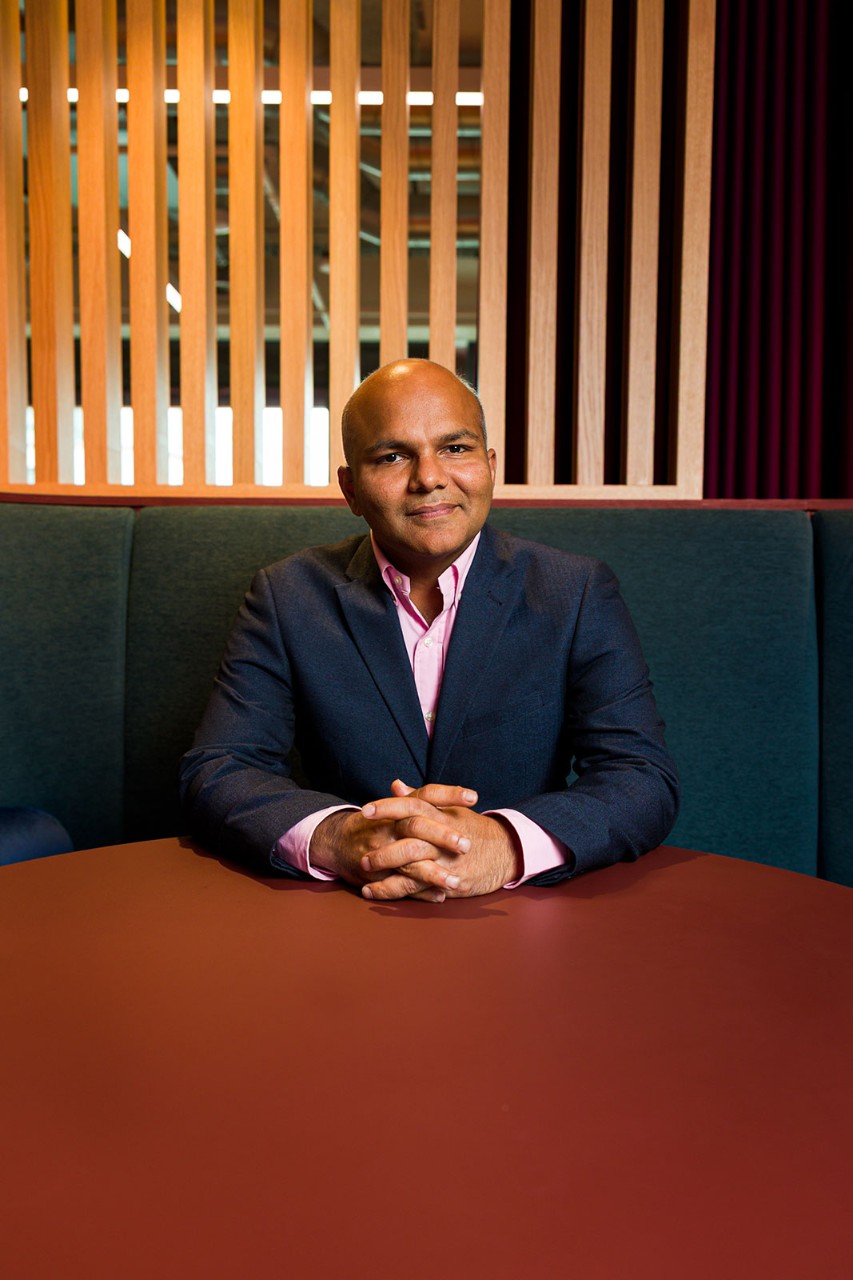
There are few sectors that can claim to come close to the current scale and speed of change as technology, media and telecoms (TMT). With significant experience within the mobile, broadband and television businesses at Sky and now Virgin Media O2 (VMO2), Rajiv Chandra FCCA knows this better than most.
‘Traditionally, the telecoms sector would never have seen OTT providers [‘over-the-top’ providers that deliver content over the internet] as a direct competitor to the established broadband market,’ he says. ‘But when streaming really took off and people started “cord-cutting” – leaving pay TV services and moving to providers such as Netflix – they didn’t just leave one part of the bundle, they would invariably consider a change to their broadband service provider too.’
The lesson learned is that disruption impacts the entire ecosystem, rather than a fragment of it.
Today, success has become about attracting and retaining not just individual customers but entire households – for their mobile phone service, broadband, content streaming and more. Chandra, now the director of finance analytics and value creation at VMO2, can see where the sector is heading.
‘The future of the telco market is convergence,’ he says. ‘Companies are working to “own”, for want of a better word, a household, and become part of the AI ecosystem.’ VMO2, of course, is no exception – but the fight for customers’ attention is fierce, and there are many big fish in the pond.
‘We want to be able to please our customers and provide more products and services, creating synergies from what they are already receiving from us,’ says Chandra. ‘But the reality is that our competition is not just from adjacent businesses; it’s the threat of what big tech companies could do next. So we are working to stay ahead of the curve and diversify risk.’
‘Reducing customer churn by one percentage point can increase revenue by tens of millions of pounds’
Critical role
Chandra and his team of data scientists, data engineers and finance professionals are playing a critical role in keeping VMO2 lean and sharp in an aggressively competitive market. Their core responsibility is to use innovative data analytics to develop opportunities for revenue and EBITDA growth, working across VMO2’s broadband, mobile and entertainment businesses.
The team creates machine-learning models to interrogate processes, look for efficiencies and examine every conceivable possibility for adding more value to the business through better customer interactions, more efficient supplier processes, and better network performance.
One current initiative, for example, is focusing on increasing revenue by optimising network asset efficiency and monetisation of ‘spare capacity’.
Powerful data
Chandra’s time working for Procter & Gamble taught him that a small change can have a big impact. ‘In the fast-moving consumer goods sector, a penny’s change in the price of a commodity or a marginal reduction in waste could have a multimillion-pound impact across the business,’ he says.
‘In the TMT sector, making infrastructure slightly more efficient creates significant value. Reducing customer churn by one percentage point can increase revenue by tens of millions of pounds.’ It is possible to add hundreds of millions of pounds in value over a few years, often by making small changes.
‘Finding accountants with advanced data skills is like looking for a unicorn’
This is the power of data and data analytics. ‘We are using more and more data at an individual customer level to examine and improve existing processes,’ he says. ‘How can we eliminate delays to customer installations? How do we prioritise the customers who need help in real time?’
The mix of data scientists and finance professionals in his team is ideal, he says, but also a necessity. ‘The finance team of the future will be very cross functional, adept at working with large datasets and skilled in using advanced visualisation tools,’ he says. ‘We must change the perception that finding finance professionals with advanced data skills is like looking for a unicorn.’
Understanding the numbers
Professional accountants have an essential role to play. ‘It’s natural for the finance team to understand the commercial outcomes that could be a game-changer for a business because we’re so close to the numbers,’ he says.
‘We are on the cusp of something very special’
This ability to understand what a business needs will become even more important as technology continues to develop, he adds.
‘We are on the cusp of something very special with potentially unlimited AI resource and a landscape that allows us to operate with more precision than ever before. But people need to understand how to use data and, more importantly, why use it. We’re not trying to create theoretical data products; we are trying to solve very practical problems.
‘I always return to the problem that we are trying to solve,’ he says. ‘AI is just another tool in your endeavour to serve customers better. It’s important not to get distracted from that.’
Award winner
As a data specialist who recently won the GENCFO Pioneer Award for the use of data and AI within the finance function, Chandra is adamant that the value of professional accountants has not changed.
‘It’s very easy for businesses to buy into the hype of AI and analytics, and think about how they can use as many of these tools as possible. But I think it’s important that we remain true to our core. Being ACCA qualified sets you up in the sense that you know how to ask the right questions.’
The CV
2024
Director, finance analytics and value creation, Virgin Media O2
2021
Head of finance analytics, operating efficiency, Sky
2015
Senior finance analyst, Sky Broadband and Talk
2011
Various finance roles at Procter & Gamble,
2007
Managing director, Lubricant Oil, India