How are you with Shakespeare quotations? I’m sure a few spring to mind: ‘To be or not to be…’, ‘Wherefore art thou Romeo?’ or ‘My kingdom for a horse!’
But what about this, from Hamlet: ‘That hath in it no profit but the name.’
Here’s a line from Othello: ‘By debitor and creditor: this counter-caster, He, in good time, must his lieutenant be’.
And how about this gem from Macbeth: “…to make their audit at your highness’ pleasure”.
Yes, these are all references to accounting. In fact, Shakespeare’s plays and sonnets are full of metaphors drawn from the world of bookkeeping. He uses ‘audit’ or ‘auditor’ 13 times, and ‘creditor’ just as often, while ‘expense’ crops up 21 times. Meanwhile, variants of ‘profit’ appear an astonishing 71 times.
Money runs as a rich seam throughout Shakespeare’s work
Why are there so many references to accounting but almost none about, say, seafaring? I have a suggestion. We all know of Shakespeare as a playwright, poet and linguistic genius, but he was also something else: an accountant.
Head for figures
This may sound far-fetched, but you don’t have to dig too much into Shakespeare’s life to realise that he would have needed a good head for figures.
He was a shareholder in the Globe Theatre in south London. He also bought property from which he earned rent. He managed his own investments and he probably helped to oversee the theatre’s ledgers, too. (Somebody had to!) By his late 40s he could afford to retire to Stratford-upon-Avon, where he died in 1616 a relatively wealthy man.
Money runs as a rich seam throughout Shakespeare’s work: everywhere you look there are people who owe money, or are trying to steal it, pay it, borrow it, lend it or earn it. And Shakespeare doesn’t just talk about cash; there are plenty of clues that he understood the emerging practice of double-entry bookkeeping, which was still relatively new in Elizabethan England.
Here for, example, is a quote from Act 5 scene 4 of Cymbeline, in which the jailer likens the hangman’s noose (a rope or cord that can be bought for just a penny) to – of all things – an accountant sorting out the debits and credits of the victim’s life:
‘O, the charity of a penny cord! it sums up thousands in a trice: you have no true debitor and creditor but it: of what’s past, is, and to come, the discharge: your neck, sir, is pen, book, and counters; so the acquittance follows.’
Most accountants were more confident using counters than the new arithmetic methods
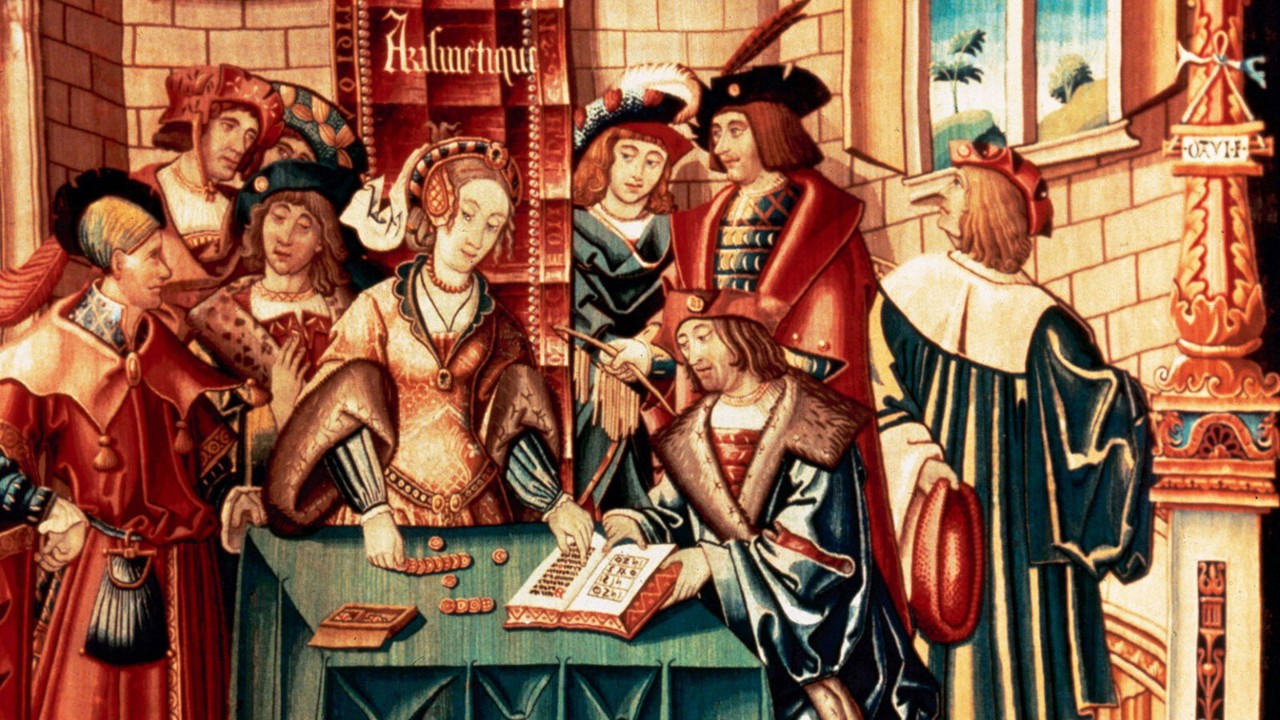
The ‘counters’ mentioned here were coin-like tokens called ‘jettons’ that were used to tally accounts on a lined counting board, similar to an abacus. In Shakespeare’s time, most accountants were more confident adding and subtracting using counters than using the new arithmetic methods, however efficient the latter were.
Settling the accounts
The word ‘reckoning’, meaning the settling of accounts, appears more than 40 times in Shakespeare’s work, often metaphorically. In Macbeth, when Malcolm becomes king he says to his soldiers:
‘We shall not spend a large expense of time
Before we reckon with your several loves
And make us even with you’
Here, the debts he is paying off are ones of loyalty and friendship, rather than money.
In The Comedy of Errors we see another financial term, the ‘mark’: ‘Where is the thousand marks I gave thee, villain?’
The mark was a monetary unit of account worth two-thirds of a pound (or 160 pennies). But it wasn’t a coin you could hold; it was a bookkeeping term. If a merchant sold an item for, say, 26 shillings and eight pence, a bookkeeper might instead write ‘sold for two marks’.
Shakespeare could just as easily have had his character demand the ‘thousand pounds’ or even the ‘four thousand crowns I gave thee, villain’. But instead he brought in an accounting term that would have been less familiar to his audience.
Shakespeare was making a topical reference to an unpopular tax
Taxing times
Even taxes don’t escape his attention. In Henry VI Part 2, a messenger grumbles: ‘My lord…here’s the Lord Say…he that made us pay one and twenty fifteens, and one shilling to the pound, the last subsidy.’
The messenger is talking about two distinct taxes here. The first is the ‘fifteenth’, a tax on movable goods that dated back to 1334. Taken literally, “one and twenty fifteen(th)s” would be a tax rate of 21/15, an extortionate 140%, which is more than the goods being taxed were worth! Tax historians regard this as an example of Shakespearean exaggeration, to emphasise how unfair the people thought these taxes were.
On top of the fifteenths there is the ‘subsidy’ tax of one shilling in the pound, which is a 5% levy. A tax of exactly this amount had been imposed by Queen Elizabeth in 1589, so it seems that Shakespeare was making a topical reference to an unpopular tax that richer members of his audience would have been only too aware of.
The calm, calculating face in front of me was the spitting image of my accountant
It should also be said that Shakespeare was not fond of paying taxes himself. For example, a ‘William Shackspeare’ (Elizabethans were very flexible with spelling names) appears three times between 1597 and 1600 in the London tax commissioner’s report for the parish of St Helen’s Bishopsgate, listed as owing five shillings, and later 13 shillings and four pence, in unpaid taxes.
It has been joked that the bust of Shakespeare above his tomb made him look like ‘a self-satisfied pork butcher’. But when I visited Holy Trinity Church in Stratford-upon-Avon to look at the famous effigy, it struck me that the calm, calculating face in front of me didn’t belong behind a butcher’s counter; it was the spitting image of my accountant.
So, there we have it. The man who wrote the greatest books in the English language may have been quietly balancing them, too.


