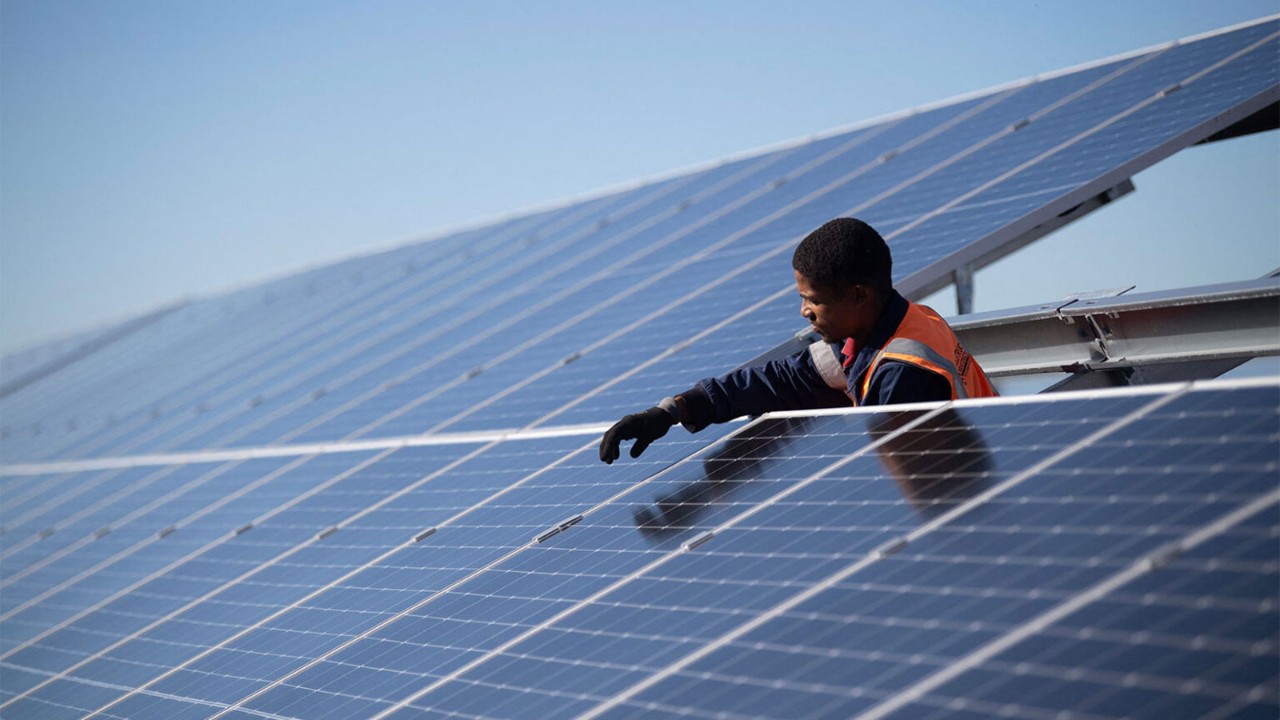

Across Africa, roofs are gradually being covered by solar panels as companies and households respond to the continent’s perennially unreliable and increasingly expensive electricity. But while the money being poured into batteries, captive plants, mini-grids and private power contracts is greatly boosting reliability and creating investment opportunities, it also means that the electricity companies’ most profitable customers are exiting just when those companies need them most.
In sub-Saharan Africa’s biggest economies, Nigeria and South Africa, electricity utilities have been unable to deliver the power needed to drive either economy. The Nigerian grid has an installed capacity of about 13,600 MW but delivers under 5,000 MW to an economy that needs over 30,000 MW.
Power from the grid is unreliable and blackouts are common. Households and businesses are used to having to make alternative private power arrangements, but where this used to be via petrol and diesel generators, it is now inverters, solar panels and batteries. Africa saw its fastest-ever solar expansion in 2025, with growth coming from both utility-scale projects and privately financed systems.
Unreliable power is bad for business
It’s not just in South Africa and Nigeria. The same is happening in most parts of sub-Saharan Africa. In Zambia, Zimbabwe, Ghana and the Democratic Republic of the Congo, mines are seeking captive power arrangements and direct supply from independent producers. Telecom operators across Africa are installing solar and hybrid systems at base stations. Shopping malls, hotels, banks, farms, schools, hospitals and industrial estates increasingly produce at least some of their own electricity.
Consumers are taking power into their own hands because unreliable power is bad for business and makes life difficult. Power cuts interrupt production, damage equipment and reduce productivity. The situation is made even worse by the reduction and removal of electricity subsidies across countries like Nigeria.
New power economy
Meanwhile the cost of alternative power is falling as Chinese companies ship humongous quantities of solar panels and batteries to Africa. Governments are making it even easier by easing restrictions on power generation, dropping tariffs on imports of alternative power generating equipment, and even encouraging domestic manufacture. Supported by the environmental benefits of cleaner power, the choice is a no-brainer.
The financing for this new ecosystem opens up a trove of opportunities
A new investment ecosystem is developing outside the traditional utility structure. Companies increasingly purchase power under long-term agreements, and energy-as-a-service arrangements allow third parties to provide on-premises power. Consequently, the provision of electricity is becoming a competitive service rather than an exclusive product supplied by a territorial monopoly.
The financing for this new ecosystem opens up a trove of opportunities for pension funds, infrastructure funds, development finance institutions and domestic capital markets. This is because private power projects still face the traditional hurdles of high interest rates, currency mismatches and limited availability of long-term finance.
Utility death spiral
The growth of this parallel electricity economy has consequences for the public system. Electricity utilities carry high fixed costs. Transmission and distribution networks must be maintained, generating plants kept in working order, and employees, suppliers and lenders serviced.
Utilities’ most valuable customers are now becoming the competition
Utilities depend disproportionately on industrial, commercial and affluent residential customers who consume large volumes, pay generally higher tariffs and are more likely to settle their bills. These are the very customers most capable of investing in private generation, so not only are the utilities losing their most valuable customers, but these customers are also becoming their competition.
The question is, who will finance Africa’s public electricity networks when their best customers increasingly provide their own power?
Private generation does not benefit all consumers equally. Lower income households cannot afford the upfront investment in private power and so remain dependent on the public grid, which becomes less reliable and more expensive as wealthier customers disappear. The transition to private power could solve reliability for individual users but aggravate national energy poverty.
Solutions
One idea that may flash through the minds of many an official may be to slow the transition to private power. But while delays in licensing, import restrictions, limits and levies, or even forcing producers to feed into the public grid could preserve the utilities’ revenues for a while, they would impose far higher economic costs. With utilities losing the incentive to be innovative, the need for private investment would taper off. Regulation accordingly needs to work to integrate distributed generation, rather than suppress it.
To survive, African utilities must change their business model. Rather than just generating and selling electricity, they could also connect producers and users through reliable networks. Another option would be to ensure that the grid remains a viable backup for customers who have switched to alternatives.
Utilities should seek to make money by enabling the private-power revolution
Credible regulation, better collection, reduced losses and stronger commercial discipline are all required. Utilities should make money from enabling the private-power revolution rather than try to prevent it.
Africa’s private-power boom is evidence of innovation and resilience. The solution is not to choose between public electricity and private electricity but to build a market in which each reinforces the other. Consumers no longer want to wait in the dark for traditional utilities to provide power. They are building a new system from the bottom up. This could become one of the continent’s most important infrastructure revolutions. Governments should support it.


