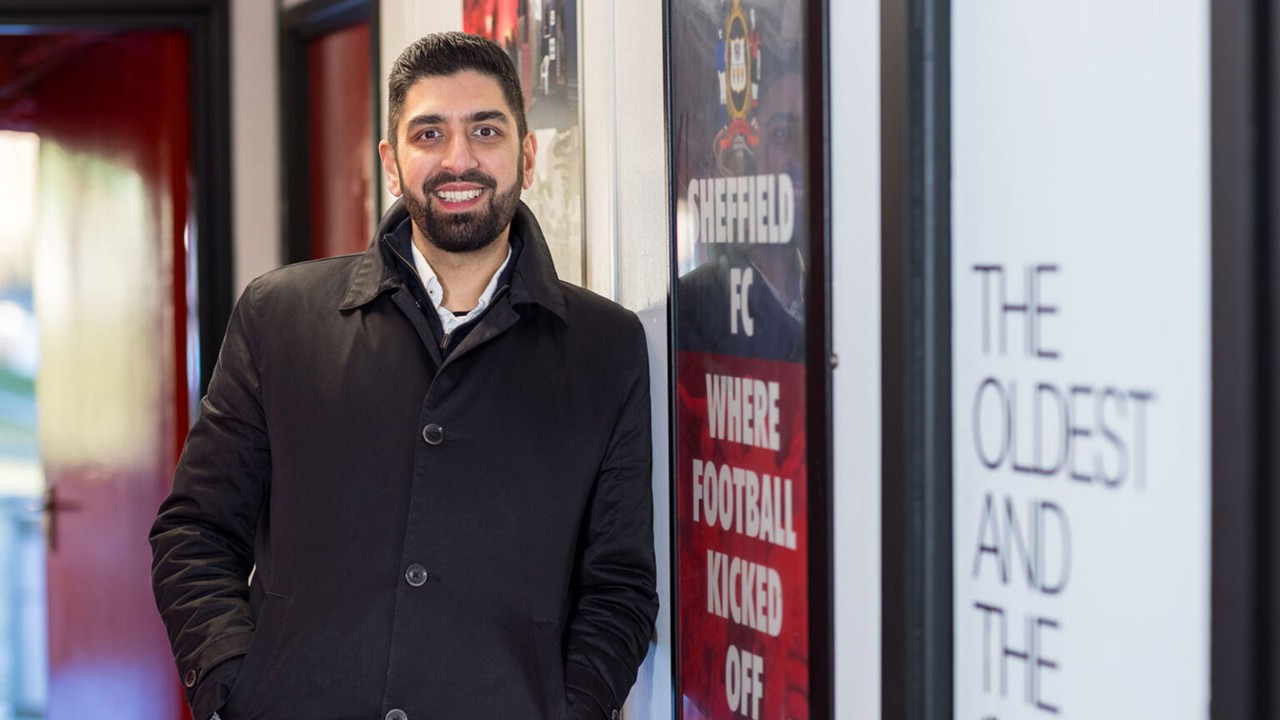
‘Football clubs build talent pools of players and managers from across the world, and similar benefits could be gained off the pitch if clubs widened the lens of where they recruit finance professionals,’ says Niaz Shazad ACCA, former CFO and co-CEO of Bolton Wanderers FC.
He knows of what he speaks, being one of only a few CEOs in English football from an ethnically diverse heritage, before he departed the club in December 2025.
Shazad has a track record of implementing pathways for budding finance professionals from diverse backgrounds into football clubs. The 37-year-old arrived at Bolton from Manchester City in 2024 where he was head of finance for the men’s and women’s team operations.
Elite access
‘One thing I am proud of from my time at City was setting up an initiative that enabled a diverse mix of students from local colleges to gain access to an elite footballing operation,’ he says.
The club has since built on the scheme, says Shazad, with City Football Group opening its headquarters so students can spend a week there, enjoying access to the facilities, talking with senior club executives, and being challenged with a variety of tasks, as well as getting support in interview preparation and skills development.
‘Many youngsters from diverse backgrounds often consider it impossible to work for such institutions,’ Shazad says. ‘But this initiative gives them an opportunity to get a foot in the door and see for themselves what a career in football could look like.’
‘I wanted to be a coach. I thought I was the next Mourinho’

At the end of the week, the students present their learnings and aspirations to a selection of club staff while posing their own questions unfiltered. ‘At the end of the first iteration of this scheme, over 30 staff turned up virtually and in person to wish the students well in their futures. It was a really fulfilling week, and I’m hopeful one day these candidates may aspire to occupy football boardrooms themselves.’
The idea came from a chat with a colleague, Zarah Shah, and Shazad’s mentor Martyn Hawkins, now CFO at Everton FC. His own hunger to succeed, he says, took root in a background that does not include a private education, attendance at a red-brick university or a Big Four firm on his CV. ‘I had a different perspective, a different lived experience, which Hawkins spotted from our very first chat and said could be my superpower.
‘If everyone asks the same questions, has the same education and professional journey, departments become echo-chambers,’ he adds. ‘But when difference is seen as a superpower, clubs benefit commercially, economically and socially.’
Football crazy
Shazad started his finance career at retailer Wilko before moving to gym group Virgin Active, but his interest had always centred on football.
‘I actually wanted to be a coach. I thought I was the next Mourinho,’ he laughs. ‘But my dad was adamant that a career in football “wasn’t for us”.’
Undeterred, he pivoted towards sports administration, taking on the role of finance business partner for matchdays at the Rugby Football Union. He describes his experience there as being a tremendous, albeit steep, learning curve.
‘I am of Muslim faith and strongly believe in fate and timing’
‘Working in English rugby was brilliant for me. I loved it – the sport, the work, the mentors. I learned so much from the likes of [England and Great Britain hockey FD] Kuldeep Kaur, [Prem Rugby CEO] Simon Massie-Taylor and [former RFU CFO] Steve Brown FCCA. There was a culture of pursuing excellence, pride and high standards every day.’
Right moment
After his mother died, Sheffield-born Shazad moved back north to be closer to his father. He joined recruitment agency Tes in 2019 after initially being rejected by Manchester City for a finance analyst position, only to be appointed to the more senior role of finance business partner for City Football Group a year later.
‘When I joined, I realised that rejection in football is about timing and fit. I am of Muslim faith and strongly believe in fate and timing. Persistence is a necessary attribute to work in the industry.’
His responsibilities initially included ticketing, hospitality and capex, but he was promoted nine months later to head of finance. The role was also expanded to incorporate women’s football.
‘I wanted to push beyond finance, to be involved in and influence policy, strategy and growth, and long-term development,’ he says. ‘I was offered an “in” to the women’s game and saw how infrastructure decisions were taken, how scouting programmes were coordinated at home and abroad, and learned about personnel decisions, transfers and player contracts. I really got to understand the breadth of football operations.’
Hot to trot
Shazad wasn’t looking to leave the club, but an agency suggested a meeting with Bolton Wanderers. ‘They told me I would relate to the people. I met the chair, Sharon Brittan, and we talked for hours. When she described football as being a potential platform to influence positive societal change, I decided to take the plunge.’
‘There is much to do on who belongs in football’s corridors and offices’
‘It was a change of mindset. City had just won the Champions League, but Bolton had not enjoyed a smooth journey in recent times. As a change agent, there was a need for strength of conviction, for clarity and to rebuild trust across the organisation – it was underperforming behind the scenes.
‘Although revenue had grown, losses had grown proportionately at a faster rate. There were missed payments, no PO system, a lack of cashflow certainty – none of which was individually disastrous but materially sub-optimal overall.
‘We managed to make significant progress within the finance function, thanks to my super team,’ Shazad says. ‘The club is on a far better footing now and can hopefully go on to secure promotion this season.’
He intends to remain in football and continue to mentor others. ‘I want to hold the ladder steadily for the next generation to climb. A lot of work has been done, but there remains much to do to challenge the status quo of who belongs in those corridors and offices. Representation matters hugely.
‘The game is global, and clubs can certainly reflect that by attracting top talent from a range of backgrounds off the pitch, as well as on it.’
Grassroots engagement
As someone who has ‘walked the same streets, attended the same schools and religious establishments’ and come from a family whose more traditional worldviews may be shared with those he’s mentoring, Shazad is well placed to give back to the local community. His activity includes:
- supporting 75 children from Sheffield to train at the City Football Group campus
- volunteering as treasurer at a local charitable foundation
- mentoring three youngsters from diverse backgrounds
- supporting an educational and sporting association that helps children in deprived areas of Sheffield.


