
As seismic shifts in geopolitics, technology and the global economy redefine the rules of business, the ACCA Hong Kong Annual Conference 2026 convened some of the market’s most prominent voices in finance, industry and public policy to confront an overarching question: how should Hong Kong SAR of China’s leaders turn uncertainty into opportunity?
Under the theme ‘Leading through volatility: Hong Kong 2026 and beyond’, the conference drew government officials, C-suite executives, senior finance leaders, academics and accounting professionals together for a day of high-level dialogue on resilience, innovation and the future trajectory of one of Asia’s most internationally connected economies.
‘Forward-looking perspective’
Opening the conference, Wilson Cheng FCCA, chairman of ACCA Hong Kong, framed the event as the organisation’s annual marquee gathering. He noted that it would examine the forces reshaping the world ‘through a personal, societal, Hong Kong SAR and global lens, to help give participants a forward-looking perspective and capitalise on opportunities’.
‘ACCA will actively collaborate with the government and provide practical recommendations’
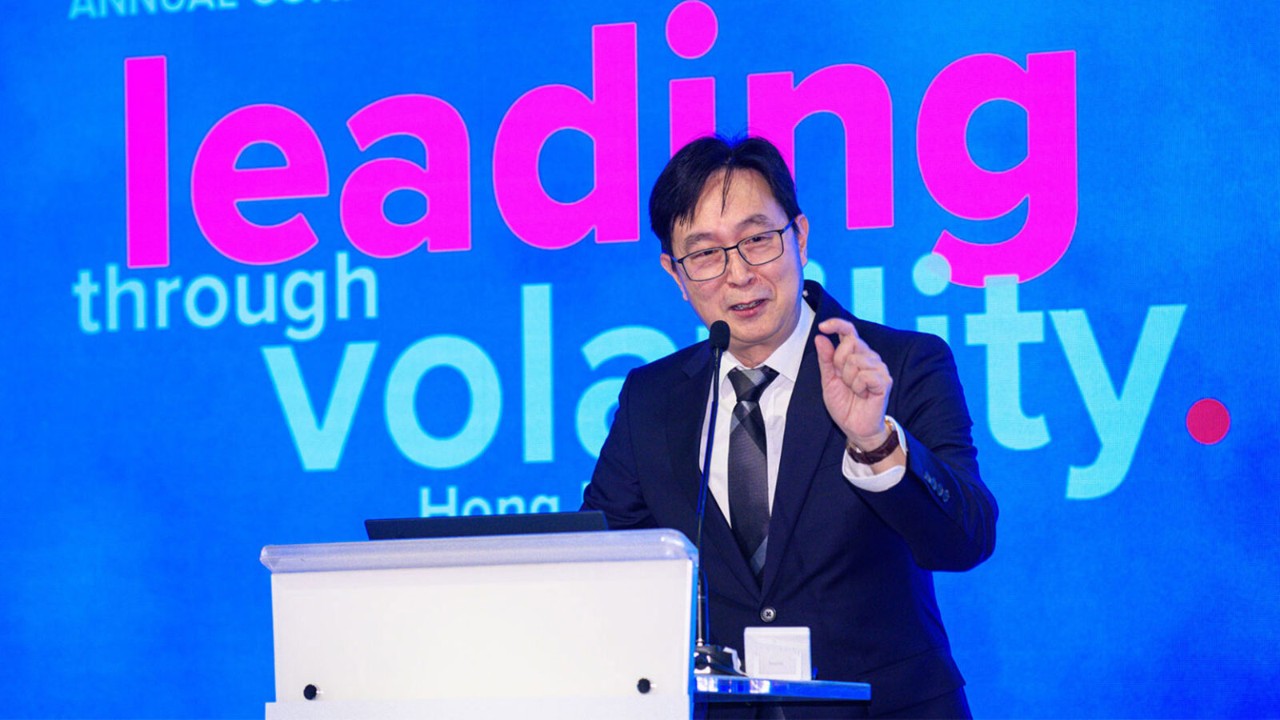
This year marks the launch of both the Chinese mainland’s 15th Five-Year Plan and Hong Kong SAR’s own parallel planning cycle, creating a rare window for the accounting profession to shape policy. Cheng signalled ACCA’s intent to step firmly into that space.
‘ACCA will actively collaborate with the government and provide practical recommendations,’ he said, adding that the organisation aims to channel ‘international experience and industry perspectives into the planning process’ to help Hong Kong strengthen its standing as an international financial centre, a global talent hub and an international innovation centre.
Navigating change
Guest of Honour Eric Ma, GBS, JP, chairman of Transport International Holdings, delivered the opening address. ‘Today’s world is in the midst of great changes, the likes of which we haven’t seen in a century,’ Ma told the audience, pointing to market volatility, economic uncertainty, geopolitical tensions and rapid technological change as forces that collectively present ‘substantial challenges for corporations’.
Ma spoke from deep operational experience. Transport International’s flagship subsidiary, Kowloon Motor Bus (KMB) – Hong Kong SAR’s largest franchised bus operator – runs a fleet of more than 4,000 licensed buses across 400 routes and carries roughly 2.8 million passengers every day.
The transportation sector, he said, has endured a rollercoaster ride in recent years, with fuel costs ballooning from roughly 10% of operating expenditure to as much as 30%. Yet Ma highlighted a structural advantage that has helped cushion the blow: ‘Hong Kong SAR’s advantage of being backed by the Chinese mainland is very visible,’ he said. ‘No one is competing for the oil supply at petrol filling stations.’
Harness innovation
On the technology front, KMB has turned to AI to optimise bus scheduling and manpower allocation. It’s a concrete example of how legacy industries can harness innovation to sharpen efficiency amid relentless cost pressures.
Ma then turned to governance, underscoring that ‘discipline, transparency, resilience and sound judgment are the cornerstones of trust’. He stressed the evolving role of the CFO, arguing that in a volatile environment, teamwork is paramount. CFOs, he said, must ground every decision on solid financial foundations while simultaneously embracing creative financial thinking.
He directed his closing comment at the profession, urging ‘all accounting and finance professionals to continue delivering clear, rigorous, reliable, transparent, accurate and timely disclosures, to further reinforce market confidence’.
Front-line transformation
The fireside chat shifted the lens from macro-level volatility to the granular reality of corporate reinvention. Elsa Wong, managing director of NEC Hong Kong, joined Ambrose Ting FCCA, ACCA Hong Kong vice chairman, for a conversation about leading transformation in a technology business.
‘Firms need to actively transform themselves to be even more agile in this day and age’
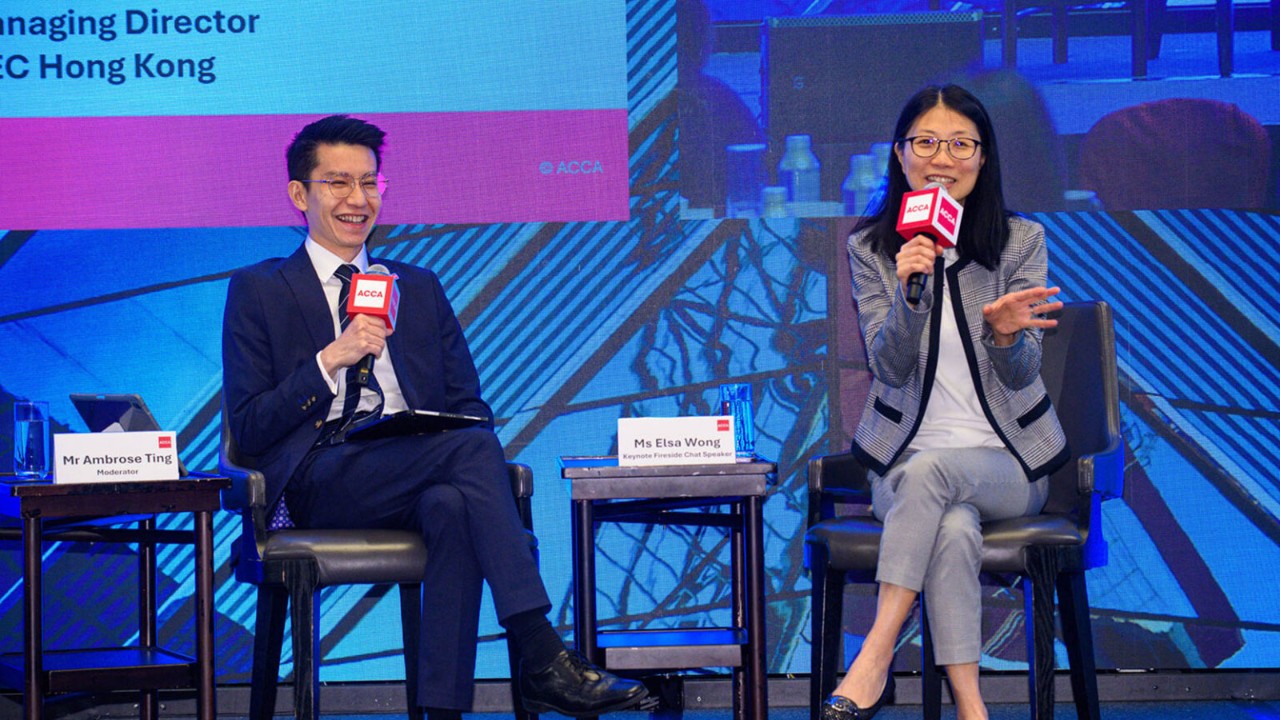
Founded in 1984 as a fully owned subsidiary of Japan’s NEC Corporation, NEC Hong Kong has evolved from a hardware distributor into a turnkey solutions provider spanning biometrics, smart transportation, video analytics and AI. Ting observed that ‘firms need to actively transform themselves to be even more agile in this day and age’, setting the stage for Wong to share the company’s own journey.
Wong recalled a period of relative comfort in the 2000s, when Japan’s economy boomed. As conditions shifted, NEC Hong Kong embarked on a deliberate strategic pivot into IT, infrastructure and, ultimately, the government and public sectors.
A simple question guided the pivot: ‘Which areas have high growth and high barriers to entry?’ NEC Hong Kong chose to invest in biometric research and development, and to build capabilities in optical fibre sensing and image recognition. The firm also developed various technologies for smart transportation, an example of how targeted innovation can unlock new revenue streams.
That bet has paid off handsomely: the US National Institute of Standards and Technology has ranked NEC’s face-recognition technology the world’s most accurate in its benchmark tests, and the company now deploys it across more than 1,000 systems in more than 70 countries, including for seamless immigration clearance at borders between the Chinese mainland, Hong Kong SAR and Macau SAR.
Practical framework
Wong offered a practical framework for recognising when transformation is overdue. External signals, she said, are relatively straightforward: declining client bases and falling sales volumes are clear red flags. Internal indicators prove subtler, particularly for hardware-oriented companies. ‘If we aren’t meeting budget, or if profit stabilises and flatlines, that usually means we need to change and explore other use cases,’ she noted.
But Wong refused to frame transformation as crisis management. ‘I don’t see it as a crisis,’ she said. What matters most is securing ‘management buy-in, determination and execution from the whole team’, because sustainable innovation depends on collective ownership. ‘They need to feel like they’re in on it for it to be a success.’
More information
Register to access the on-demand ACCA Hong Kong Annual Conference 2026


