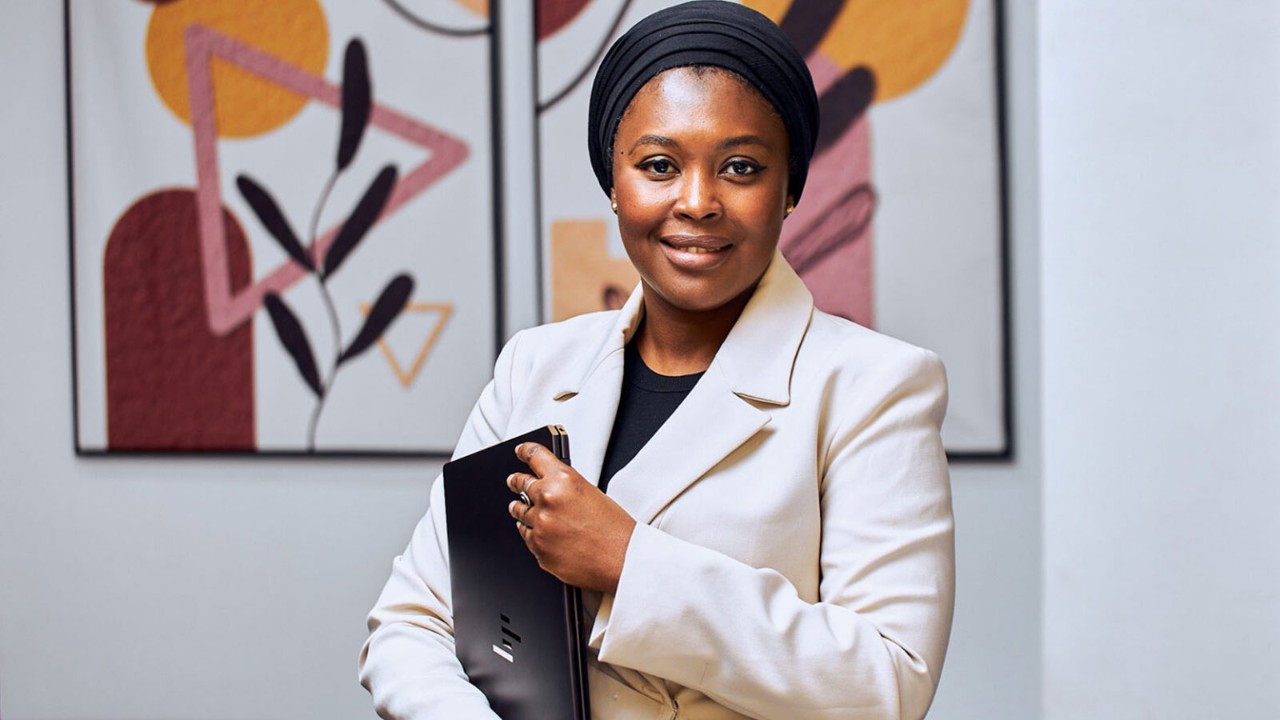
Rukaiya el-Rufai’s path to the heart of government in Nigeria has been rich and varied. As special adviser to the country’s president on National Economic Council & Climate Change, her qualifications, analytical skills and ESG credentials make her an active contributor to sustainable development.
Back in 2019, she was associate director in risk advisory at PwC. Through her work there, she found herself making introductions between clients and Nigeria’s finance minister, whom she’d met while on a part-time secondment to the Ministry of Finance a year previously. As a result, she found herself engaging in policy discussions as to the country’s future economic potential at central government level.
‘I have always believed in looking at climate with an opportunistic lens’
‘Nigeria has dire need of domestic resource mobilisation,’ she says. ‘The finance minister had a target to grow Nigeria’s GDP by 15% and we had to dissect what would come from oil, what would come from non-oil and so on.’
Her input attracted the attention of the then vice president elect. Making partner at PwC in 2020 raised her profile further – she was the first woman and only the second person from northern Nigeria to become a partner at a Big Four firm. ‘Northern Nigeria supports more than 50% of the country’s population – I’m hoping that the Big Four will become more inclusive and give a sense of belonging to more professionals from the region, particularly women,’ she says.
A seat at the table
In 2023 she took up her current position. ‘I felt it was an opportunity to give back, especially around climate,’ she says.
Every month, Nigeria’s vice president chairs a meeting where ministers, the governor of the central bank and state leaders discuss development and policy issues. ‘I advise the vice president on what resolutions are ideal for each economic agenda. It’s not just about convening – we don’t just talk, then leave,’ she says. Given her experience in sustainability, her perspective is well grounded.
It is, she recognises, a difficult time to be an advocate for action on climate change. ‘To be honest, I think the global shift has weakened climate advocates. But I have always believed in looking at climate with an opportunistic lens. My approach is that there should be a nexus between finance and economic performance with ESG growth.’
‘In Nigeria, decentralised energy solutions support agriculture best’
She cites Nigeria’s energy market – with its high use of solar energy, particularly since the start of the Russia-Ukraine war – as a good example. ‘Every country chooses what works for them. For Nigeria, it’s largely driven by economics. For example, when a fuel subsidy was removed, the cost of diesel and of fuel generally went up, and solar adoption shot up. We try to mainstream that.
‘For Nigeria, because of how challenged the grid is, decentralised energy solutions are actually the best way to support agriculture, with solar-powered irrigation pumps, for example.’
As part of a drive to promote cleaner, cheaper energy sources and eliminate high-emitting cooking stoves in homes and hospitals, Nigeria is also encouraging state-driven programmes to provide alternatives. Some 40 million households in Nigeria cook with open fires, and more widely four out of five Africans are subjected to harmful gases via cooking.
People power
El-Rufai is also national coordinator for Nigeria’s human capital development programme – another key front. With Nigeria on course to become the third most populous nation in the world by 2050, with a potential trillion-dollar economy, human capital development is a priority.
The workforce for that economy is being born and in its early years now, she points out, so how the country supports families through those early years is mission-critical. Children who are healthy, who benefit from vaccination programmes, and who are educated to the point they can learn skills and live a healthy life are the seedbed for a thriving future.
The human capital project requires grit and high-level advocacy
Embedding a programme that covers child health, education and food production – and by implication manages potential disruptions to agriculture and pricing stemming from floods and other climate impacts – takes grit and high-level advocacy. But it could hardly be more important.
‘It’s a huge project,’ she acknowledges, ‘with a very large stakeholder ecosystem. That’s where I find my strategy experience comes in very handy, in how I craft business cases, how I innovate and craft self-sustaining platforms.’
That in-built sustainability is always front of mind. El-Rufai wants to see the human capital development programme survive the current government and be taken up seamlessly by the next. ‘My aspiration is that we advocate so much for this that the ministries and the federal states all own it,’ she says.
‘I’ve always been driven by purpose, and I’ve always looked for opportunities for impact.’
CV
2023
Special adviser to Nigeria’s president on the National Economic Council’s climate change programme, Office of the Vice President
2019
Assistant director for risk advisory and head of sustainability, rising to partner in the sustainability, climate change and public sector practice, PwC Nigeria
2016
Managerial roles, Deloitte Nigeria
2013
Business specialist, Etisalat Nigeria


