The closure of the Strait of Hormuz is reshaping global shipping routes, forcing vessels away from the Red Sea and diverting them around the Cape of Good Hope – a shift that has placed Africa’s ports at the centre of global trade flows.
The disruption has created a short-term surge in traffic along African coastlines but it has also exposed a longer-term structural issue: many of the continent’s ports remain among the least efficient globally.
‘A few African ports are clearly world class or close to it, but many others are still constrained,’ says Ebrima Sawaneh FCCA, group COO and CFO at Arise Ports & Logistics.
‘Current disruptions are accelerating investment decisions that were already becoming necessary’
Sameer Bhatnagar, global head of ports at KPMG, says that the most urgent investment priorities are deep-water berths and modern terminals capable of handling larger vessels, port railroad corridors and operational and digital upgrades to reduce dwell times.
‘Without addressing these constraints, increased shipping volumes risk translating into congestion and higher logistics costs rather than economic benefit,’ Bhatnagar says.
Investment catalyst
The shift in trade patterns first occurred in 2023 following Houthi attacks on commercial shipping in the Red Sea. According to data from BIMCO, container ship transits through the Red Sea and Suez Canal have dropped by over 60% since 2023, while Southern Africa’s traffic has increased. And from 1 March to 24 April this year, daily commercial vessel traffic around the Cape averaged 20 ships, up from six in 2023, according to the International Monetary Fund.
‘The shift in traffic is short term owing to security disruptions caused by the Iran conflict,’ says Johan Greyling, infrastructure leader at Deloitte Africa. ‘There will be some beneficial traffic coming around the Cape, but that’s not the long-term driver for African ports.’
Global shipping lines typically do not deploy larger vessels, add services or commit capital for purely temporary demand spikes. According to Bhatnagar, fleet capacity on Asia–Africa services grew by more than 50% year‑on‑year in 2025, signalling expectations of sustained trade growth rather than transient disruption.
However, Bhatnagar says that evidence increasingly suggests that this is acting as a catalyst for longer‑term, structural investment in African ports. ‘In this sense, current disruptions are accelerating investment decisions that were already becoming necessary, highlighting capacity constraints, resilience gaps and the need for ports that can support evolving global trade routes over the medium to long term,’ Bhatnagar says.
Lagging behind
Africa’s port throughput has grown significantly in recent years, but performance has lagged global benchmarks. While a handful of ports – such as Port of Tanger Med – rank among the world’s most efficient, many others remain constrained.
According to Bhatnagar, Africa’s container throughput grew from approximately 19 million TEUs (twenty-foot equivalent units) in 2010 to nearly 35 million TEUs by 2022. But only a small number of ports operate at globally competitive scale and efficiency. The World Bank’s Container Port Performance Index 2023 ranked Tanger-Mediterranean fourth globally and Port Said 16th, yet most Sub-Saharan African ports in the index sit much lower, with many ranked beyond 300.
‘You can invest heavily inside the fence and still be constrained by what happens outside it’
‘Some terminals operate within reasonable conditions and can adequately absorb incremental volume. Others face hard structural limits,’ says Olalekan Olabode FCCA, a seasoned finance leader in the African logistics sector with experience at West Africa Container Terminal.
These include ‘insufficient quay length, inadequate yard depth, ageing equipment and landside connectivity that simply cannot handle higher throughput’, he says, as well as the transport network beyond the terminal: ‘You can invest heavily inside the fence and still be constrained by what happens outside it.’
Investment surge
However, a new wave of investment – much of it backed by Chinese financing and operators such as China Merchants Port Holdings and COSCO Shipping – is beginning to transform the landscape. According to the Africa Centre for Strategic Studies, Chinese state-owned firms are active stakeholders in an estimated 78 ports across 32 African countries.
More broadly, expansion projects are under way in East, West and Southern Africa, with improvements in capacity and efficiency already visible in countries such as Namibia, Tanzania, Kenya and Mozambique. Greyling notes that these regions are ‘becoming quite competitive and expanding their capacity and also their efficiency’.
But building ports is only part of the challenge. Financing them remains complex, particularly given the scale and long-term nature of the assets.
‘Feasibility does not imply bankability,’ says Sawaneh. ‘The biggest challenge is not identifying projects that are economically desirable; it is turning them into structures that are financeable at an acceptable cost of capital.’
‘For large-scale port investments, governance is not a soft issue; it is value protection’
A port becomes bankable, Sawaneh says, when it has credible demand, strong hinterland connectivity, predictable tariffs and concession terms, a serious sponsor, disciplined risk allocation and data-backed preparation. Without these, investors are reluctant to commit, especially in markets where perceived risk pushes up the cost of capital.
Bhatnagar highlights recurring execution challenges: weak planning, fragmented stakeholder coordination involving port authorities, line ministries, regulators, financiers and operators, and financing complexity. ‘Advance and comprehensive planning to ensure capacity comes up ahead and in response to potential demand is very important. Playing catch-up leads to sub-optimal solutions,’ Bhatnagar says.
Governance and execution
For finance leaders, the role extends far beyond securing funding. Governance, oversight and performance monitoring are critical to ensuring that projects deliver value.
‘For large-scale port investments, governance is not a soft issue; it is value protection,’ says Sawaneh. He points to the importance of having clear investment cases, disciplined stage gates and rigorous cost and risk reporting throughout the project lifecycle.
Return on investment, meanwhile, is measured in three layers – direct financial returns, operating return including vessel turnaround time, and the wider economic and social returns.
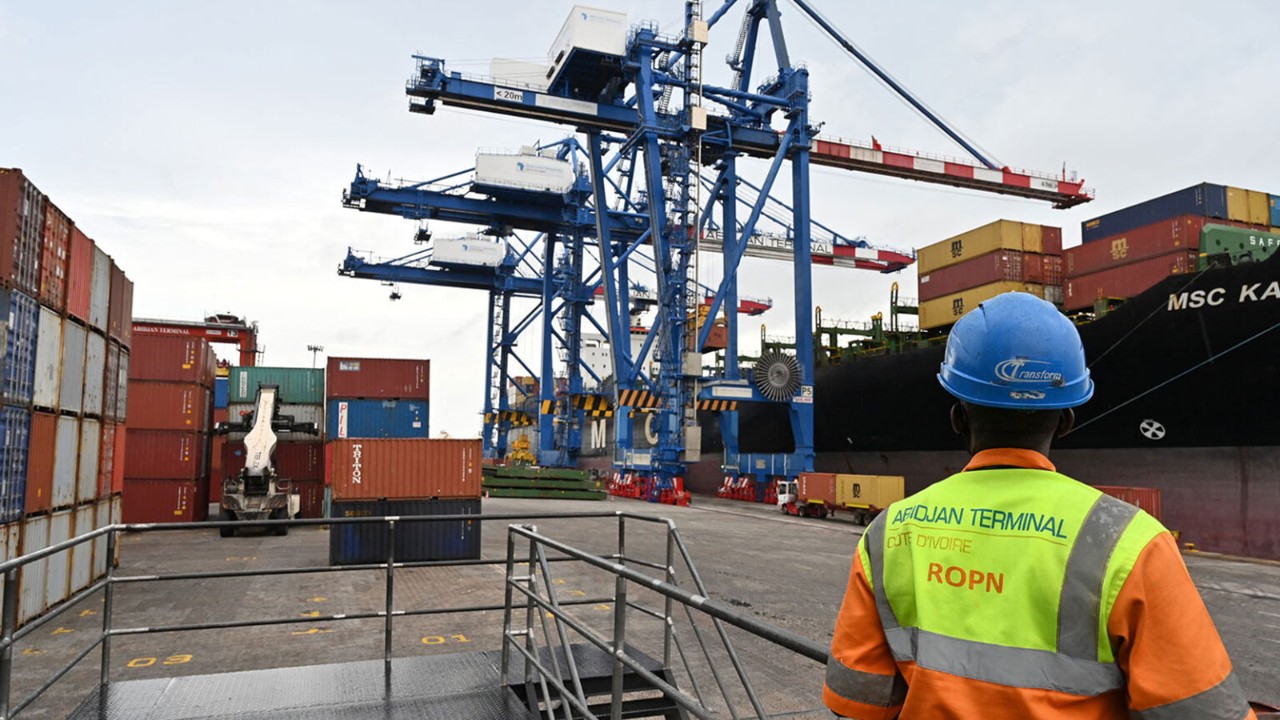
‘This broader lens matters for us and our shareholders,’ Sawaneh says, pointing to Arise Ports & Logistics’s terminal in Côte d’Ivoire, which is expected to support more than 55,000 jobs by 2030.
An example where performance has impacted operations is the MPS terminal in Tema, Ghana, says Johan Van de Peer at shipping line Ocean Network Express (Europe). ‘The terminal management has invested in adequate quay equipment to reduce the swell surge and increased the generator capacity to ensure a stable power supply. This has positively impacted the vessel stay and allows the terminal to recover rapidly from any disruptions,’ he says.
Olabode’s experience at West Africa Container Terminal illustrates this in practice. A recent US$115m upgrade delivered measurable improvements in capacity, productivity and vessel turnaround times.
‘A meaningful share of the transformation was driven by the adoption of lean methodology, deliberate investment in local talent development, a strong and collaborative regulatory partnership, and genuine community buy-in,’ he says. ‘These are not soft footnotes to the capital story; they are the foundations that made the investment perform, and they will be just as critical to sustaining and building on these gains going forward.’
Financing constraint
In some markets, however, structural constraints limit the pace of investment. In South Africa, for example, port infrastructure is largely controlled by state-owned entities, with funding tied to the balance sheet of Transnet, the state-owned logistics company.
‘The challenge is not the availability of capital for bankable projects,’ says Greyling. ‘It is the ability of the state entity to fund its portion of the infrastructure, such as new quays, dredging for larger vessels and port layout changes that require significant capital expansion.’
This highlights a broader issue across the continent: while private capital is often available for terminal operations, core infrastructure – long-lived, capital-intensive and slow to generate returns – remains dependent on public funding or development finance.
Encouragingly, new models are emerging. Blended finance approaches, public-private partnerships and initiatives such as South Africa’s Budget Facility for Infrastructure (BFI) aim to crowd in private investment while addressing public sector constraints.
For instance, the South African government recently issued a bond specifically to fund or support the funding for the BFI, which, Greyling says, ‘could be a very attractive bond for the institutional market and pension funds’.
‘It is long dated and a stable income,’ he adds. ‘That money still sits on the government balance sheet, but it is a more structured and sensible approach to port infrastructure.’


