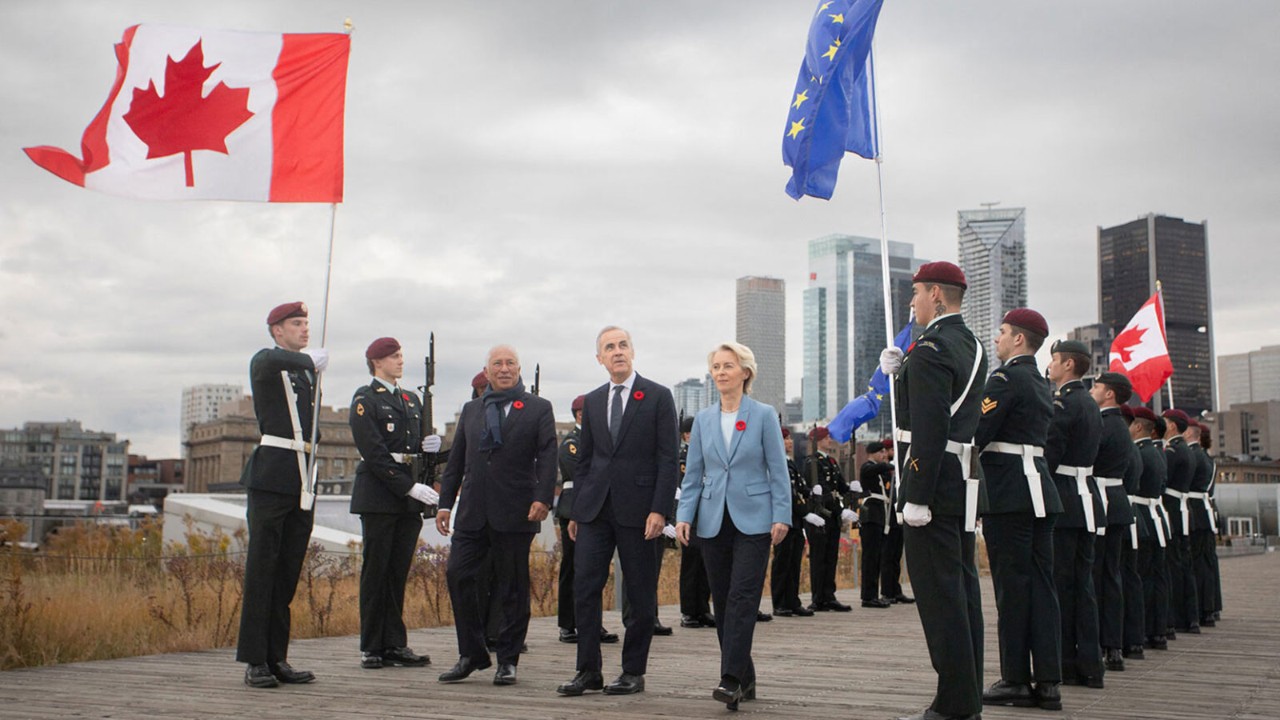
On 16 September 2026, Ursula von der Leyen, president of the European Commission, used her State of the Union address – with Canada’s prime minister, Mark Carney, in the chamber – to invite Canada to become the EU’s first associate member. Leaders have subsequently met in Montreal for an EU–Canada summit, providing an opportunity to flesh out a potential deal.
The move comes as Canada’s dependence on its very large southern neighbour loosens, albeit from a high level. The US share of Canadian goods exports fell to 68.5% in the 12 months to July 2026, from 74.1% a year earlier, according to Statistics Canada data, though much of the increase in exports elsewhere was gold and other precious metals.
‘Giving it a name when it does not actually exist means you then have to define it afterwards’
‘Europe is a central pillar towards diversification,’ says Mauricio Zelaya, partner and national economics leader at EY-Parthenon in Canada, who cautions against ‘replacing dependence on the US with dependence on another market’.
Strategy shift
So far, neither side has said clearly what the status would involve. The EU treaties make no provision for associate members, and any arrangement would not give Canada a vote in EU institutions. ‘Giving it a name when it does not actually exist means you then have to define it afterwards,’ says Peter Ferrigno, director of tax services at Henley & Partners.
Its significance is partly symbolic: for Canada, a show of independence from the US; for Europe, a statement of its own strategic autonomy. Any agreement could take years to finalise. That said, the invitation may also mark a shift in how the EU deals with countries outside its borders.
‘There’s lots of room for opportunity for trade between Europe and Canada’
‘This is potentially an important signal that Europe is open to a more à la carte menu,’ says Andrew Kenningham, chief Europe economist at Capital Economics. ‘Traditionally, it has been all you can eat: you had to meet all the criteria and be fully integrated.’ That could have implications for potential deals with Ukraine or the UK, he says.
The commercial prize lies in removing restrictions and aligning rules more closely, or simply recognising each other’s. ‘When you look at how Canadian exports are actually divided up, there’s lots of room for opportunity for trade between Europe and Canada,’ says Joy Nott, a retired trade and customs partner at KPMG in Canada.
On the shelf
Much of what closer ties might offer already exists on paper. The Comprehensive Economic and Trade Agreement (CETA) has applied provisionally since 2017. While not every EU member state has ratified it, much has been put in place regardless, says Kenningham, and talks on the mutual recognition of professional qualifications are under way. By September 2024, CETA had removed customs duties on industrial goods altogether.
‘That free trade agreement is a wonderful tool in Canada’s tool belt, but it’s sitting there with an inch of dust on it,’ says Nott. Canadian exports to Europe rose only modestly after CETA took effect, she says – far less than the Canadian government had hoped. ‘It’s not a duty issue.’
‘A lot of Canadian companies have never really given Europe a lot of thought’
Part of the explanation is that many Canadian companies never looked. Focused on the US, ‘A lot of Canadian companies have never really given Europe a lot of thought,’ she says. Faced with 27 countries, ‘they don’t know what they don’t know, which makes it very intimidating’. She often suggests to nervous exporters that they start with the UK, where CETA’s terms carried over after Brexit and language is no barrier.
For those that do look, the obstacle is a second set of rules: labelling in several languages, and engineering standards long aligned with those of the US. Bringing a product into the European market means having it approved against European standards, and ‘there is cost, there’s time and there’s red tape’ in doing so, according to Nott.
That matters for accountants, because the barriers that remain are compliance costs. Product certification, testing, origin documentation and the systems that track which rules apply to which product sit with finance, tax and compliance functions. Together, they decide whether a European contract is still profitable once the cost of qualifying for it is counted.
Two rulebooks
The harder question is what aligning with Europe would do to Canada’s ties with the US. Canada already shares a free trade area with the US and Mexico under the United States–Mexico–Canada Agreement (USMCA). Most Canadian goods still cross that border duty free: the effective US tariff rate on them, meaning duties collected as a share of import value, was 3.2% in August, according to US Census Bureau data, against 7.1% across all US imports, according to the Penn Wharton Budget Model.
‘Converging with the EU means diverging from the US’
‘If you already have regulatory convergence with the US under the USMCA, then converging with the EU means diverging from the US,’ says Ferrigno. Canadian manufacturers, he argues, would have to turn out two production lines: one to North American standards, one to European.
Nott qualifies that. Companies ‘would need to have enough business to justify two production lines’, she says. And the gap often runs deeper than the shape of a plug: a hairdryer built to North American electrical standards may not meet European ones, because the rules cover how hot the motor runs as well as how it connects. ‘Often they’re close, but they’re not identical.’
Alignment would bring its own costs first. ‘Businesses would bear much of the initial cost through new certification, customs, rules-of-origin, carbon reporting and tax compliance requirements,’ says Zelaya. The burden, he says, would fall hardest on smaller exporters, online retailers and carbon-intensive producers.
‘The gains would first likely appear in investment partnerships and supply chain reshaping, followed by exports,’ says Zelaya, who sees Europe as a source of capital, technology and offtake agreements – contracts in which a buyer commits in advance to take a project’s future output, which can make a mine or energy project financeable. The test, he says, is ‘whether companies commit capital differently from before’ in new investment, European procurement contracts and projects that reach a final investment decision.
Skills before software
The bottleneck may be people. Specialists in trade and customs compliance are common in the US but scarce in Canada, says Nott; Canadian companies so often relied on American parents or customers to tell them which rules applied ‘because everything was duty free, and if you wanted to know the rules, the Americans would explain them’.
With rules changing faster than companies can hire experienced specialists, professional services firms have invested in technology, including a tool that uses a company’s trade history to show management, in real time, what moving production between countries would cost in duties. ‘You can build technology faster than you can train more people like me,’ says Nott.
Whatever the arrangement is eventually called, the preparation for finance teams is the same: knowing which products could be certified for Europe and at what cost, whether supplier data can prove where goods come from, and whether anyone in the business understands the rules well enough to use them.
A new generation is starting to treat trade compliance as a career, Nott says. ‘We’re at the very, very beginning of that.’

