By the end of this year, the European Central Bank’s Governing Council will decide whether Beethoven will appear on the new euro banknotes. The nine other proposals for the face of the euro are built around two themes: European culture, and rivers and birds. The legendary German composer (1770-1827) will go up against plumed competitors such as the kingfisher and the white stork, as well as the likes of Maria Callas.
Of all European composers, it makes sense that the ECB would consider Beethoven’s face for the job. His music has historically transcended political boundaries and so aligns with the ECB’s values of supranational independence. Between 1956 and 1968, for example, the Ode to Joy from Beethoven’s ninth symphony was used as the national anthem for the unified football team of East and West Germany at the Olympic Games, and has been the anthem of the European Union since 1985. It looks as though the storks are up against some stiff competition.
Best of the West
Figures from the world of music have long been popular icons to feature on currencies around the world.
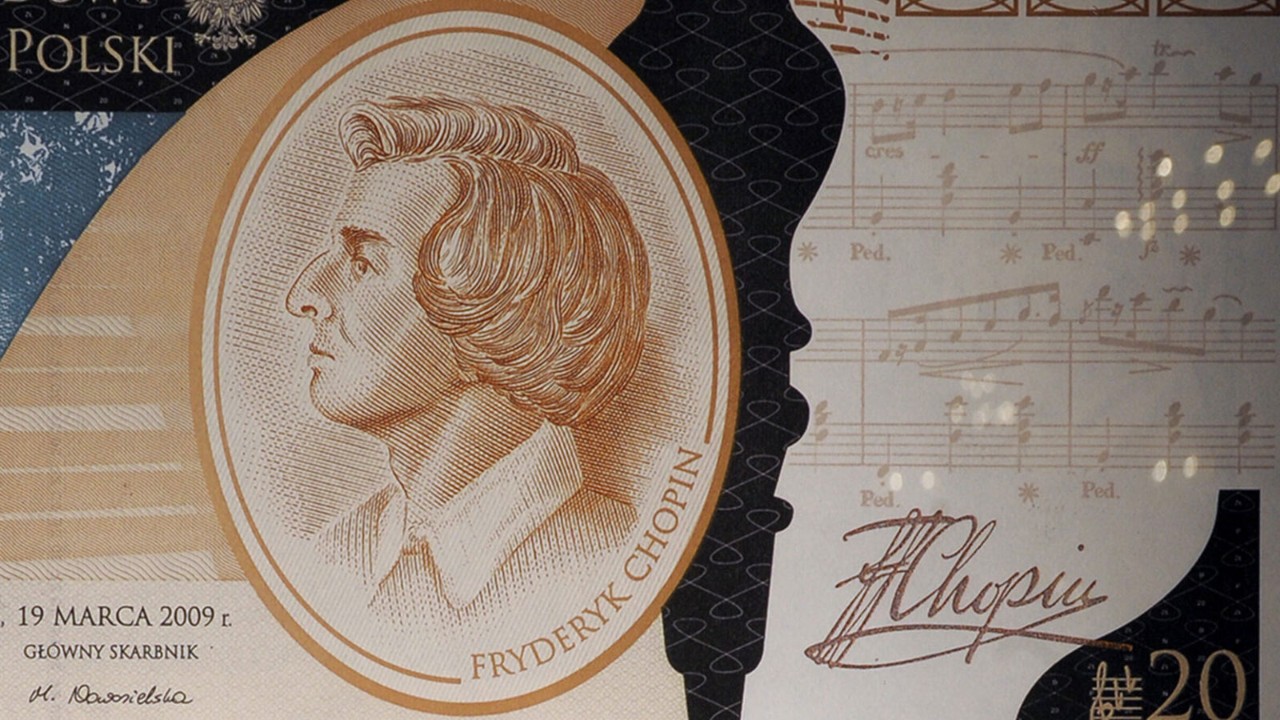
One significant example from Europe outside of the eurozone is Poland’s most famous composer, Frédéric Chopin (1810-1849), whose pieces epitomised romantic piano music. A limited 20 złoty banknote was issued in 2010, the ‘Year of Chopin’, commemorating the 200th anniversary of his birth. It features score fragments from two pieces: the Mazurka in B-flat major and the Etude in F minor.
Although Chopin emigrated to Paris in 1831 and never returned to Poland, he was deeply patriotic. He never felt comfortable speaking French, and always carried a small container of Polish soil around with him. On his deathbed, Chopin requested that the Polish national anthem, Jeszcze Polka nie Zginela (‘Poland is not yet lost’) be sung for him.
All that jazz
North America also has a history of celebrating its musical heroes on its currency, including two of the most legendary jazz musicians, showing that their lives and work were monumentally significant for the national identity of their countries.
Duke Ellington was the first Black American to appear solo on a circulating US coin
In 2009 Duke Ellington (1899-1974), one of the US’s most important composers, was added to the reverse side of a District of Columbia quarter, becoming the first Black American to appear solo on a circulating US coin. Ellington – who played a crucial role in the Harlem Renaissance, an African American intellectual and cultural movement – is seated at the piano, holding sheet music, above an inscription of the DC motto, ‘Justice for all’.
Meanwhile, in 2022 Canada issued a commemorative circulation one-dollar coin celebrating Oscar Peterson (1925-2007), a Black Canadian pianist whose first major composition – Hymn to Freedom – was synonymous with the 1960s US civil rights movement. The composition is inspired by the blues and gospel sound that Peterson would have heard at spirituals as he grew up in Montreal. Peterson contributed to more than 500 recordings in a career that spanned the 1940s right up until his death.
King of swing
Although faces on currency often belong to monarchs or political figures, Thailand commemorates a man who was both of those – and a musician.
King Bhumibol Adulyadej, known as Rama IX, ruled Thailand from 1946 to 2016 and loved Dixieland jazz. As he presided over a period of geopolitical and economic transformation, he also played saxophone, clarinet, trumpet, piano and guitar, writing 49 compositions that ranged from swing to marches, waltzes and Thai patriotic songs. While he appeared on many notes and coins during his long reign, Rama IX’s musical passion is most prominent on the 100-baht note issued in 2011, which shows him playing the saxophone.
The 1979 10,000 rupia banknote featured a full Javanese gamelan ensemble
The currency of Indonesia, meanwhile has offered a more traditional musical take. The 1979 10,000 rupia banknote featured a full Javanese gamelan ensemble with all the traditional instruments on display: the metallophones and xylophones, which carry the melody, and the many percussion instruments – such as gongs – that lay down the rhythm.
Gamelan performances date back to the 8th century, and in 2021 the genre appeared on Unesco’s list of the Intangible Cultural Heritage of Humanity. The idea of having an ensemble made up of ordinary people on a banknote is a strong indicator of music’s universality and makes striking a contrast with Western currencies.
Even if Beethoven never heard gamelan, his music is symbolic of a similarly unified orchestra – the eurozone. The ECB’s potential decision to have a musician on a banknote would certainly demonstrate its values – arguably more than the white stork.


