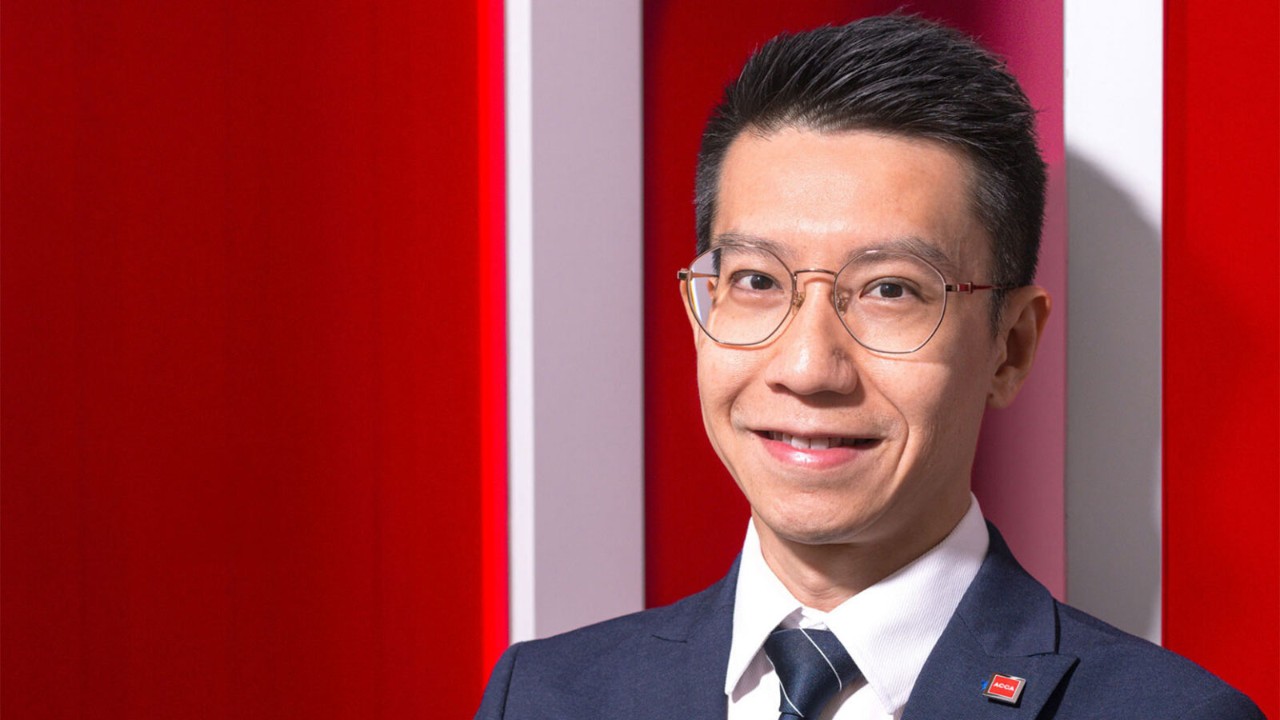
ACCA Hong Kong’s incoming chair Ambrose Ting has spent much of his career living somewhere other than where he started.
For over 27 years, he has moved between Hong Kong SAR of China, Sydney, Beijing, Zhuhai and Shenzhen, while audit engagements have taken him from Singapore and Malaysia to Tibet, Europe and, more recently, Kazakhstan. The border he rates most highly, though, does not appear on any map.
‘Real crossing over isn’t just about moving geographically,’ he says. ‘It’s about shifting the way you think.’
‘ACCA members should get out of their comfort zone’
That single idea sits at the centre of the agenda Ting brings to his new role as chair of ACCA Hong Kong for 2026/27. Having joined the Hong Kong committee in 2020 and served as vice chair over the past year, he is taking the chair at what he calls ‘a period of change we may only see once in a century’. And his message to members is a simple one: ‘Get out of your comfort zone.’
Border crossings
Ting joined the profession straight out of university, beginning at PwC in Hong Kong before moving to the firm’s Australian practice as a manager and then returning to PwC Mainland China and Hong Kong, where he became a partner. In September 2025, he joined Deloitte China as a partner in audit and assurance.
Each posting, he says, added a different layer. Australia gave him first-hand exposure to how seriously Western business treats governance and transparency. Beijing and the Greater Bay Area taught him how Chinese mainland companies think and make decisions.
‘Hong Kong’s strength has never been in going it alone,’ he says. ‘It’s in acting as a translator, turning international rules into language Chinese mainland companies can understand, while turning Chinese market opportunities into value that international investors can actually see.’
His work in central Asia and Europe reinforced the point. ‘We’ve watched a lot of different markets go through trial and error. We know which roads lead somewhere and which ones don’t. That kind of institutional memory isn’t something you can learn from a textbook.’
Connection, on three levels
Little wonder, then, that Ting has chosen ‘connection’ as the theme for his term. He applies it on three different levels.
The first is geographical: from Hong Kong SAR to the Greater Bay Area, from the Greater Bay Area to the Chinese mainland, and outward to the world.
The second is intellectual, carrying the profession’s traditional strengths into new territory such as AI, sustainability and corporate governance. It also means lifting members’ line of sight from the local market to the national picture, including Hong Kong SAR’s first five-year plan.
The third is about values. ‘The ultimate mission of the accounting profession is using our professional capability to build a better world,’ he says.
‘Members should treat ACCA’s global network as their external brain’
Underpinning all three levels is the membership itself. Ting wants members to treat ACCA’s global network as their ‘external brain’. ‘Whatever problem you are facing in Hong Kong today, another member somewhere has probably already solved it,’ he says. ‘Working out how to tap that experience is something every member should be thinking about.’
First principles
As an audit and assurance partner, Ting takes up the role of chair just as technology is reshaping the mechanics of his own discipline. Most conversations about AI, he says, fixate on cost savings, but that misses the point.
‘The whole profession is facing a serious resource shortage, in commerce and professional services alike, at exactly the moment when financing activity and business models are becoming more complex,’ he explains. ‘AI is the tool that fills the gap between an increasingly complex environment and finite resources.’
‘AI is an opportunity to get back to what audit is fundamentally about’
Whether it turns out to be opportunity or risk is a matter of attitude. ‘If accountants master AI and build it into their work, it’s an opportunity. If we let AI lead us around by the nose, it’s a risk,’ he says.
As routine work migrates to machines, he expects practitioners to become more specialised and more focused on value delivery. Audit, he suggests, is getting to return to first principles. ‘AI gives us a wonderful opportunity to get back to what auditing is fundamentally about: thinking, professional judgment and genuine enquiry. That means putting quality ahead of efficiency.’
Credibility and talent
Ting makes a similar argument about trust in sustainability reporting. Companies are increasingly judged on their environmental, social and governance (ESG) performance, yet those figures are rarely tested the way financial figures are. ‘If ESG data is being used to make investment decisions, it has to be as reliable as the numbers in the accounts,’ Ting says. Independent assurance and audit, in his view, is the missing piece.
And that, in turn, leads back to people. The global competition for finance skills has become a generational battle as much as a numbers problem, he says. ‘Younger entrants want meaning, impact and flexibility, and accountancy’s inherited image sits awkwardly with all three.’
He sees ACCA’s future ACCA qualification, launching globally in mid-2027, as part of the answer. Employability modules are built into every level, with technology, ethics and sustainability running through the syllabus rather than sitting alongside it. Students are also recognised stage by stage instead of all at once. ‘It’s a chance to reposition the whole profession,’ he says.
Which brings him back to where he began: ‘Step out geographically. Step out professionally. And take Hong Kong’s experience with you,’ he says. ‘There’s a whole new world out there.’


