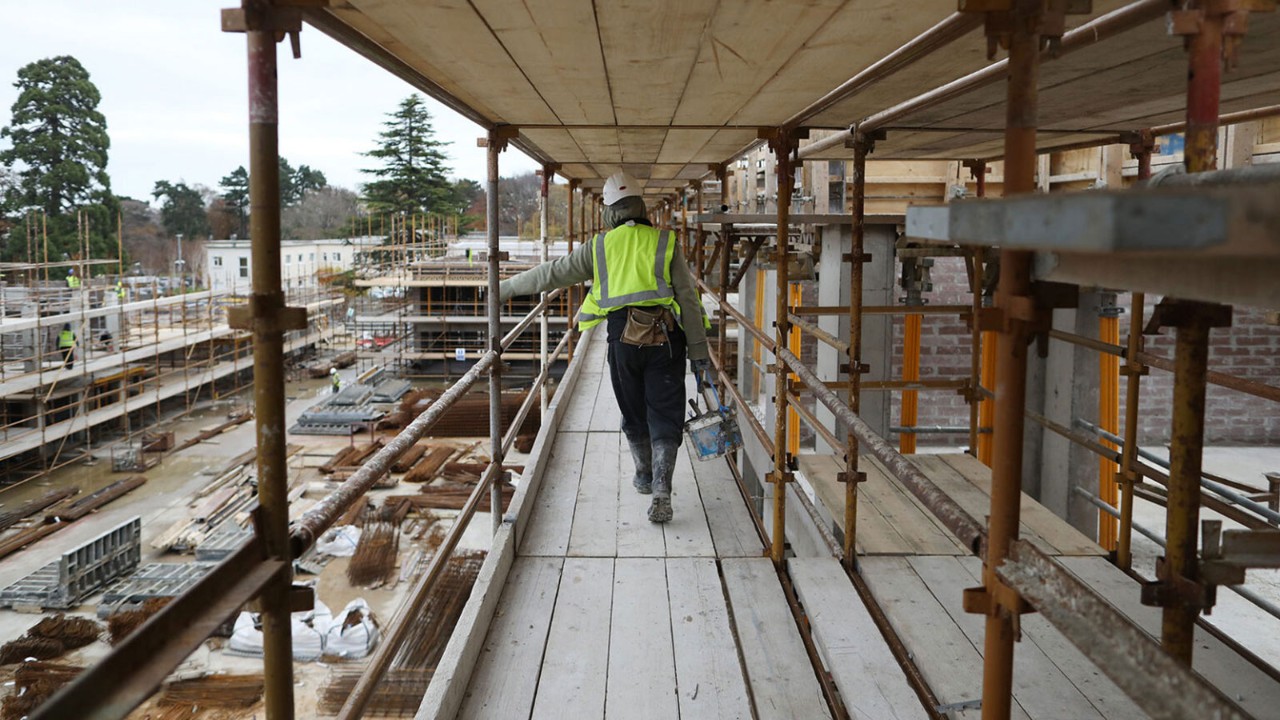
Any sizing up of Ireland Inc’s strengths and weakness typically brings two familiar themes together. In one corner, a thriving, export-focused economy; in the other, a punishing housing crisis. This year has proved no exception: EY forecasts Irish GDP will grow by 9% this year, while both house prices and homelessness figures hit record highs this autumn.
A 2024 survey by Dublin Chamber found that two-thirds of companies in the capital have lost staff or potential recruits because of the housing situation. Ibec, the group that represents Irish business, says 27% of its members see housing availability for employees as one of their top three external priorities.
‘Property-based tax incentives are a politically sensitive policy lever’
Kevin Callinan, general secretary of Fórsa, the country’s largest public sector trade union, has commented that ‘the Irish economic success story is being actively undermined by the ongoing accommodation shortages’, while Ian Lawlor of private equity firm Roundtower Capital, suggests that the housing crisis ‘threatens to undermine the country’s economic prosperity and social fabric’.
Critical shortage
A recent trend among larger companies has been to take the challenge into their own hands. Euro News reported in January that ‘companies such as Ryanair, Supermacs, Killarney Hotels, and Musgrave, amongst others, have all chosen to spend more on staff housing benefits in order to attract and retain staff’.
It’s an approach beyond the resources of the typical SME, a sector that the Consultative Committee of Accountancy Bodies – Ireland (CCAB-I), of which ACCA is a member, has said is increasingly at risk as the accommodation crisis creates a recruitment minefield.
CCAB-I has, in recent years, raised the alert on ‘a critical shortage of qualified accountants in Ireland’, successfully making the case that accountancy should remain on the government’s Critical Skills Occupations List. The current housing crisis presents further complications for a profession struggling to meet capacity shortages.
In July, as part of its 2026 pre-Budget submission, CCAB-I addressed the housing crisis directly – recommending the introduction of a capital allowance ‘for developers/investors on either or both the sales proceeds of developments and the rental income of developed units’ as one way of dealing with the ‘seemingly insurmountable bottleneck in the supply of housing’.
‘Demand for new apartments is largely limited to well-paid young professionals’
While recognising that ‘property-based tax incentives are a politically sensitive policy lever’ after the Celtic Tiger years, CCAB-I argued its approach had the right ‘design features’ to incentivise the building of critical housing stock such as apartment blocks, independent living facilities and student accommodation.
The long haul
Housing provision forms a key part of the current Programme for Government, which commits to delivering 300,000 new homes between 2025 and 2030. According to some analysis, apartments could form up to 50% of these, but question marks remain over Ireland’s willingness to embrace apartment living over the long haul. Earlier this year, estate agents Hooke & MacDonald reported that the construction of apartments for the private rental market had ‘ground to a virtual halt’.
Writing in The Irish Times, planning lecturer Nicholas Mansergh argues that ‘market demand for new apartments is largely limited to well-paid young professionals who are happy to rent’. The OECD notes that apartments and flats account for just 14% of all housing stock in Ireland, compared with an average of 40% in OECD countries.
A litany of structural issues connected to Celtic Tiger construction practices has also done little to improve perceptions of apartments, but nevertheless, their central place in urban planning remains indisputable.
Central Statistics Office data suggests movement in the right direction
In July, the government bowed to pressure from the construction industry by revising apartment building regulations to allow for smaller units, fewer windows and less communal internal space. Minister for housing James Browne said that the moves would cut construction costs by between €50,000 and €100,000 per unit.
Help on the way
When details of Budget 2026 were announced on 7 October, it became clear that CCAB-I’s recommendations had provided food for thought. The Irish Times reported that ‘kick-starting the construction of apartments across Ireland appears to have been the main aim of the housing measures in Budget 2026’. It pointed to a reduction in VAT on the sale of new apartments from 13.5% to 9% and also noted ‘reductions, and in some cases exemptions, on corporation tax involved in the building of new apartments, and the rental profits of cost-rental schemes’.
Carmel Logan, partner and head of real estate at KPMG, agreed that the measures represented an attempt to address Ireland’s housing challenges ‘head on’, albeit with concerns about the wording around the reduced 9% VAT rate. ‘We do not see a reason to differentiate between apartments which would be owner-occupied or those which serve the rental market,’ she said.
Other housing-related measures announced included extending the Help to Buy scheme, which offers first-time buyers a tax rebate of up to €30,000, and upping the budget allocation to the Department of Housing, Local Government and Heritage to €11.275bn.
‘Higher housing output comes with risks to the economy and public finances’
While few will view the 2026 Budget as a game changer, data from the Central Statistics Office (CSO) in October suggests movement in the right direction. The number of new homes built in July, August and September was up 4% on the same period last year, which the CSO’s Steven Conroy said included a sizeable boost in apartment completions – ‘up 30% between January and September 2025 when compared with the same period in 2024’.
The clamour for action on the housing crisis is set to intensify in 2026. A 2024 report from the Central Bank highlights the dichotomy facing policymakers in uncertain economic times, pointing out that ‘transitioning to significantly higher housing output also comes with risks to the economy and public finances’.
Having found the ear of government through its pragmatic, reasoned approach, the hope will be that CCAB-I can report genuine progress rather than more of the same when it plans its pre-Budget submissions next year.


