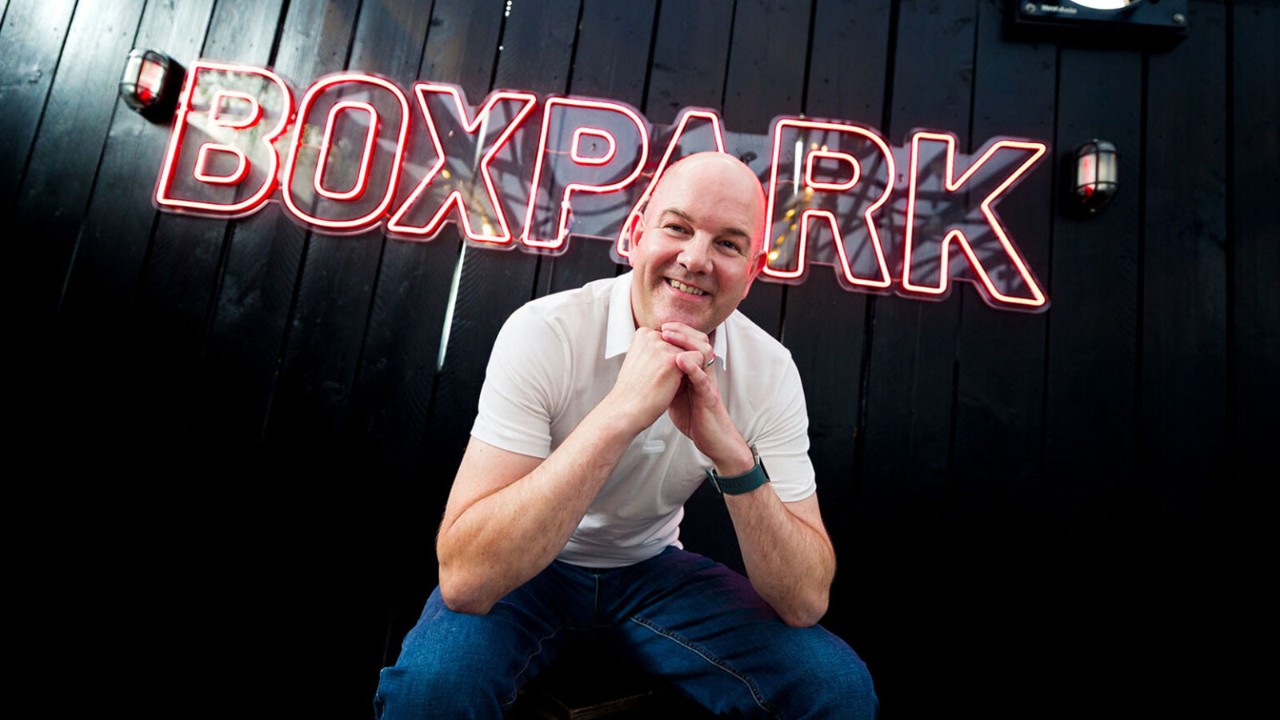
‘I went to Boxpark Shoreditch with my 14-year-old daughter the other day,’ says Chris Burford, CFO of the award-winning hospitality and leisure company. ‘It got quite busy and she turned to me and said, “Dad, this is the coolest place you’ve ever worked”.’
It’s quite the accolade from a teenager in any circumstances, but in Burford’s case it’s all the more notable because he has, objectively speaking, worked for some very cool companies. His very first job as a trainee accountant was with P&O Events at the late, lamented Earl’s Court Exhibition Centre in London.
‘You become so connected to the company’s culture that you want to be part of it’
‘It was amazing,’ says Burford. ‘We used to sit in the main hall with our sandwiches at lunchtime and watch the bands practise – Oasis, David Bowie, Alanis Morissette, Sheryl Crowe – or walk around the London Motor Show or Ideal Home Exhibition.’
All about instinct
Over the following years his employers included Hamleys, Teletext (at a time when the internet was barely off the ground), and the restaurant chains Wagamama and Leon in their early years of rapid growth.
‘Entrepreneurial businesses have been a theme of my career,’ he says. ‘I love the power of entrepreneurs’ ideas. Everyone talks about the importance of data these days, but entrepreneurs make so many decisions based on their instincts or beliefs. John Vincent [the co-founder of Leon], for example, decided that Leon’s menu should be based on natural fast-food, known for its flavour, health and innovation – innovation like the gluten-free chicken nuggets, which flew off the pass. No data would have predicted their popularity.’
CV
2025
CFO, Boxpark
2024
Senior finance director, Asda Express
2021
Finance director – UK and Ireland, EG Group
2015
Director of finance/CFO, Leon Restaurants
2006
Financial controller, Wagamama
2001
Group financial controller, Hamleys of London
1998
Management accountant, Teletext
1996
Management accountant, P&O Events
Burford watched and learned from every entrepreneur he worked with and is left with two fundamental beliefs. The first is the power of culture. ‘Culture was so important at Wagamama, recognising that the teams were key to the success of the business. It was such a welcoming place; I still love going there.’
The second is that that entrepreneurs’ eye for detail sets them apart. ‘The entrepreneurs I’ve worked for have all known everything there is to know about their business. They used to spend all their time in the restaurants or sites. They want to see what is happening and how the customers interact with the offering.’
‘It really helped in the interview that I could talk about what I’d seen and felt’
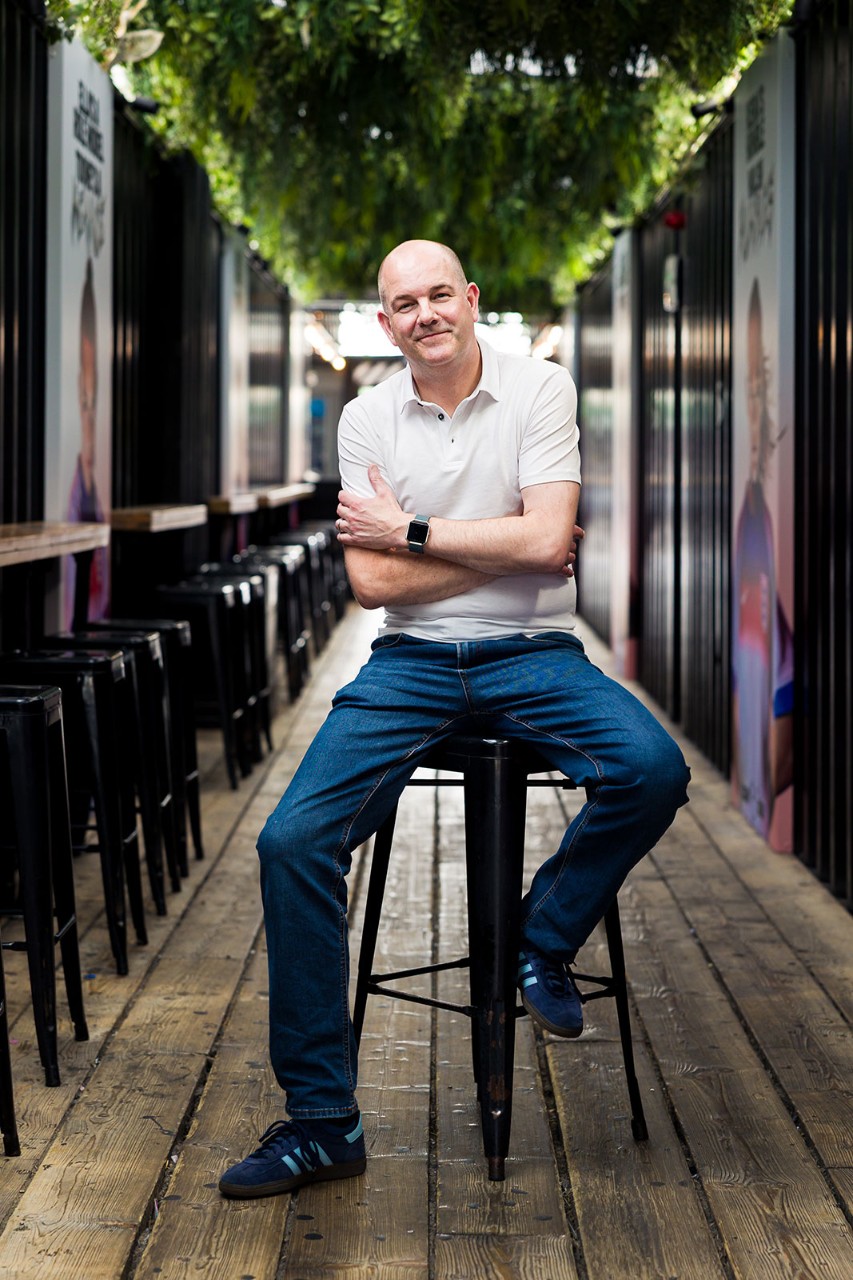
When the opportunity to join Boxpark came up, Burford focused on preparation. ‘I always do my research, so I went to the venue at Wembley one Saturday with the kids and we had an amazing time. It really helped in the interview that I could talk about what I’d seen and felt about the place.’
Boxpark is in a phase of careful growth and has come a long way since the first site opened in east London in 2011, as a pop-up shopping, street-food and entertainment destination built around a series of shipping containers. The defining feature of the sites – Croydon opened in 2016, Wembley in 2018, Shoreditch in 2022, Liverpool and Camden in 2024, and the latest in London’s Liverpool Street earlier this year – is that they offer a wide range of street food from independent traders, as well as entertainment and bars. And not all are the same – Liverpool Street’s ‘Boxhall’ site is a social dining concept, while the Croydon venue has ‘Playbox’, which features ‘competitive socialising’ such as digital shuffleboards, smart darts, pool tables, karaoke booths and arcade games.
‘One of the great things about Boxpark is that if you go out with the family or in a large group, not everyone wants the same food,’ says Burford. At Boxpark, it’s no problem; its app allows customers to order food and drinks from multiple traders from their table in a single transaction.
Formula for success
But Boxpark is also very much about entertainment. Sites can host up to 600 events a year, from the large screens (a screening of a live episode of EastEnders attracted a huge crowd) to kids’ activities, dance classes and live music. (Stormzy has played several pop-up gigs at the Croydon venue.) But it’s the football ‘watch parties’ that have really put Boxpark in the public consciousness; live footage of Boxpark customers going messily berserk at goals scored during the Euros (both men’s and women’s) have become iconic.
‘You have to remain relevant to the consumer and that’s hard in the world of social media’
It’s a successful formula. The company saw its revenue surge by 178% after Covid-19, to £18.9m for the year to April 2022, and reached £20.5m in 2023 thanks to the football World Cup. With help from private equity investment, it plans to explore ways to expand the brand.
But finding the right venue is challenging, as the concept needs space and the company favours heritage or industrial buildings. The London Liverpool Street site, for example, covers 14,000 square feet of the restored Edwardian Metropolitan Arcade.
Boxpark in numbers
2011
First Boxpark opened, in Shoreditch, east London
£19.9m
Turnover in year to April 2024
£2.2m
Operating profit in 2024
6
Number of venues
‘We need a lot of people to make a Boxpark work, and they are not cheap to build,’ says Burford. ‘At the moment the leadership team are working on the future strategy of the business, which will look at the Boxpark brand and where we can take it. We’re looking at opportunities in the UK and around the world.’
He is confident, though, that Boxpark is here to stay. ‘You have to remain relevant to the consumer and that’s hard in the world of social media, where people make decisions so quickly. It’s important that our events remain relevant, and we can see that they are through the number of people who turn up. We create the moments – that’s the secret to our success.’


