
AI and sustainability are driving sweeping changes in the finance world, pushing professionals to adapt to new ways of working. At ACCA Singapore’s Annual Conference 2025, ‘Navigating Permanence in Disruption: The Future of Trade, Talent and Transformation’, industry leaders outlined strategies for future-proofing organisations and professionals in the new era.
Sustainability metrics have become critical to global capital allocation decisions as investors confront the systemic risks of climate change. This was a central theme during the panel discussion ‘Sustainability Imperative – Beyond Compliance’, moderated by Chiew Chun Wee, ACCA’s regional lead policy and insights, Asia Pacific.
Jeanne Stampe, lead policy adviser at Norges Bank Investment Management, explained that while large funds typically maintain some protection against isolated climate events through broad market investments, climate change poses unique challenges.
‘On average, we hold one-and-a-half percent of all listed companies globally. We have an inherent interest in achieving global sustainability goals, because we can’t diversify or hedge against systemic risks such as climate change.’
‘We operate in a constantly evolving business environment’
As a long-term investor, Norges Bank actively engages with boards and executives on sustainability goals. The bank has divested from over 600 companies due to ESG-related financial risks since 2012. Their engagement strategy has shown measurable results. ‘At the end of last year, 74% of the financed Scope 1 and Scope 2 emissions in our portfolio were covered by net zero targets, up from 67% in the previous year,’ noted Stampe.
Commitment through action
The bank also closely monitors how companies manage sustainability risks as an indicator of board oversight effectiveness. Last year, Norges Bank voted against 96 directors across 23 companies ‘due to mismanagement of climate risks, because we see that the boards are not adequately overseeing how climate affects long-term value creation and capital allocation,’ Stampe explained.
According to Chock Ker Ching FCCA, CFO at MSIG in Singapore, sustainability must be woven into the core business strategy. ‘We need to build this into our strategy and make sure every financial decision accounts for environmental and social impact. It’s not just a regulation exercise,’ she said.
‘We need to move beyond just dabbling around with ChatGPT and GenAI and really harness it’
For insurance companies, climate change directly threatens profitability as increasingly severe and frequent natural disasters drive up claims and underwriting losses. ‘For us as an insurance company, we operate in a constantly evolving business environment where existing and new risks have grown and are evolving,’ Chock noted. ‘We need to cut through the ESG noise to see what exactly is sustainability bringing to our business.’
New reality
The transition to sustainability brings new regulatory challenges. For instance, many companies remain unaware of impending carbon tax obligations, said Vincent Lim FCCA, CFO at Singapore’s Agency for Science, Technology and Research.
Lim said that professional accountants can help businesses develop strategies that balance profitability with compliance. ‘Can we design our business strategy so that our company can earn money and reduce risk? We are trained to look into the future and do scenario planning. Not everyone thinks that far ahead,’ he noted.
The second panel discussion, ‘Redefining the Digital Frontier – AI, Data and the Evolving Role of Finance’, moderated by Sharifa Nafisa FCCA, managing partner and CEO at Kingsman and Associates, made clear that AI is already revolutionising how financial professionals approach their work, and those who haven’t adopted it should start now.
‘How are you creating an organisation that’s truly agile in its learning?’
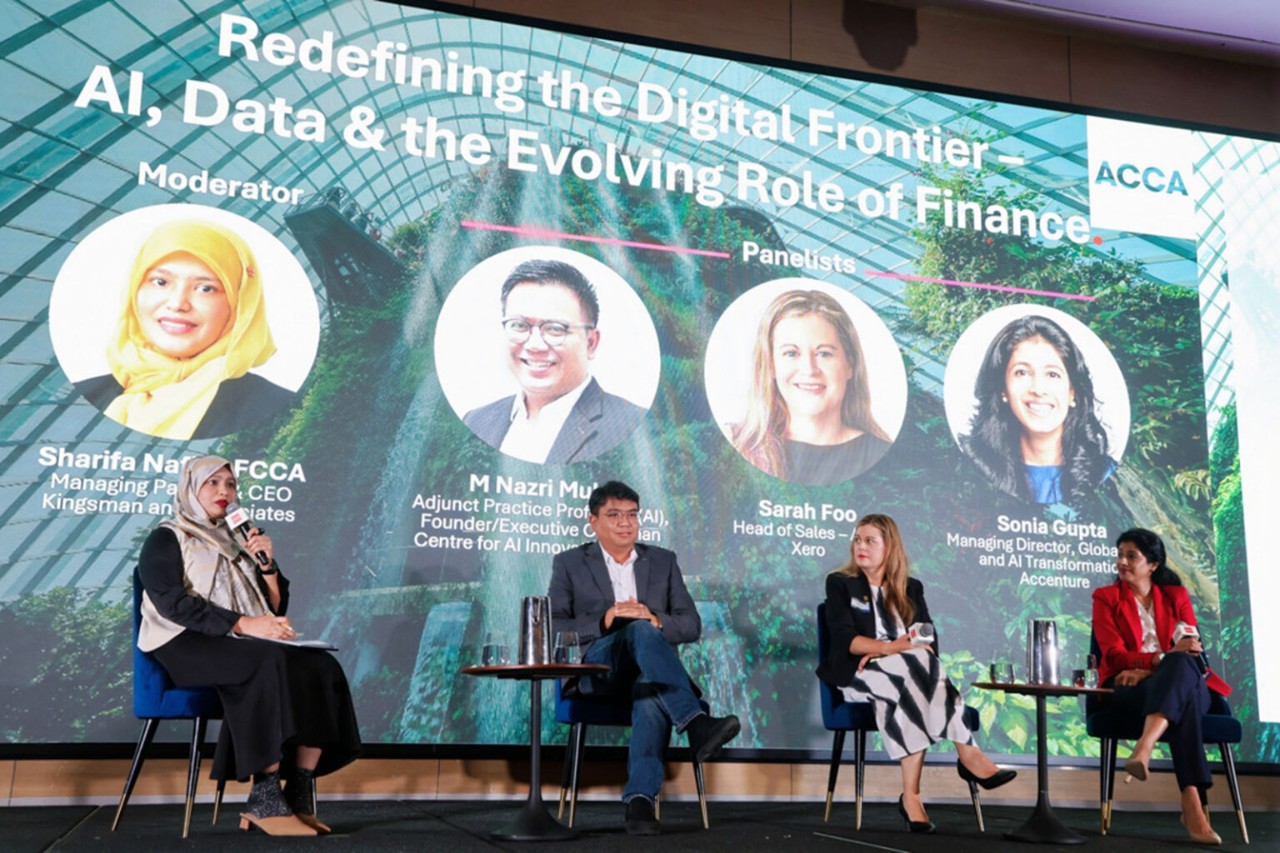
‘We need to move beyond just dabbling around with ChatGPT and GenAI and really harness it,’ said Sarah Foo, head of sales in Asia at Xero. But successfully implementing AI takes more than simply providing universal access; it requires a systematic approach to scaling across organisations and professional teams.
‘Let humans do what they do best,’ said Sonia Gupta, managing director for global data and AI transformation at Accenture. She explained that as AI systems become more sophisticated and integrated into workflows, they will transform how organisations create and measure value. ‘How are you creating an organisation that’s truly agile in its learning?’ she asked.
Tailor solutions
According to M Nazri Muhd, adjunct practice professor at the Centre for AI Innovation, CFOs can deploy AI across nine areas of operation: business valuations, financial health checks, business partnering, fundraising, restructuring, leverage optimisation, mergers and acquisitions, budgeting and action planning.
To do so, organisations and professionals need to develop their own specialised AI solutions, instead of relying on generic tools, said Nazri. ‘Create your own intangible asset that’s able to do more than what current generative AI can do. Focus on domain specialisation; don’t focus on generic GenAI tools,’ he advised.
The panellists concurred that business leaders implementing AI solutions must focus on achieving measurable outcomes, ensuring data quality, maintaining system transparency and using AI to enhance rather than replace human workers.
Professionals need to maintain visibility and control over AI systems, and not treat them as black boxes, according to Joshua Chang, founder of 8am Business. ‘All of this should be in the hands of the user, rather than letting AI run its course,’ he said.
As compliance and accounting tasks become increasingly automated, professionals can redirect their time to more valuable work, said Foo. ‘If you can use AI to prepare for meetings, for getting you client-facing ready, that’s really going to set you apart,’ she explained.
‘Keeping the human in the loop is really important,’ said Foo. ‘You need to keep your professional skills and judgment, and not take everything as gospel. It’s important to keep an inquisitive mind.’