
For years, the global sustainability narrative followed a familiar storyline: renewables steadily rising, fossil fuels gradually declining and climate ambitions tightening in a predictable arc. But that storyline no longer reflects the world we live in. AI is redefining how, where and how much energy the world will need.
Datacentres consumed roughly 415 TWh of electricity in 2024, a figure the International Energy Agency (IEA) expects to more than double by 2030. AI is growing exponentially, with servers running around the clock to train models, process information and deliver real-time outputs to millions of users. AI server farms behave less like offices and more like industrial plants, drawing power incessantly day and night. In simple terms, AI’s rise ensures that global electricity demand will climb significantly rather than plateauing.
The digital economy consumes far more power than predicted
Energy expansion
For more than a decade, the IEA has predicted that global fossil fuel demand would peak before 2030. Yet its latest World Energy Outlook, released before COP30 in November, shows that under the current policies scenario (which reflects policies already in place), demand for oil and gas continues to grow to 2050, electricity consumption rises sharply, LNG expansion accelerates and the global system adjusts to a digital economy consuming far more power than earlier models predicted.
This will require significant investment. The IEA and OPEC estimates the world needs between US$540bn and US$640bn every year in oil and gas investment to maintain supply and meet consumption. A 2024 study by the International Energy Forum and S&P Global Commodity Insights suggests that avoiding future shortages will require US$4.3 to US$4.9 trillion in cumulative upstream investment by 2030.
This new reality is reshaping the global conversation at major energy events. Leaders are no longer discussing a clean handover from one energy system to another, but a future where all sources are expanded. The emerging consensus appears to be that the world cannot simply phase out hydrocarbons and we must use every available form of energy – oil, gas, solar, wind, nuclear – to meet intensifying demand.
This is the essence of energy addition, not transition, a recognition that the scale of today’s digital and economic growth surpasses the capacity of any single pathway on its own.
Triple force
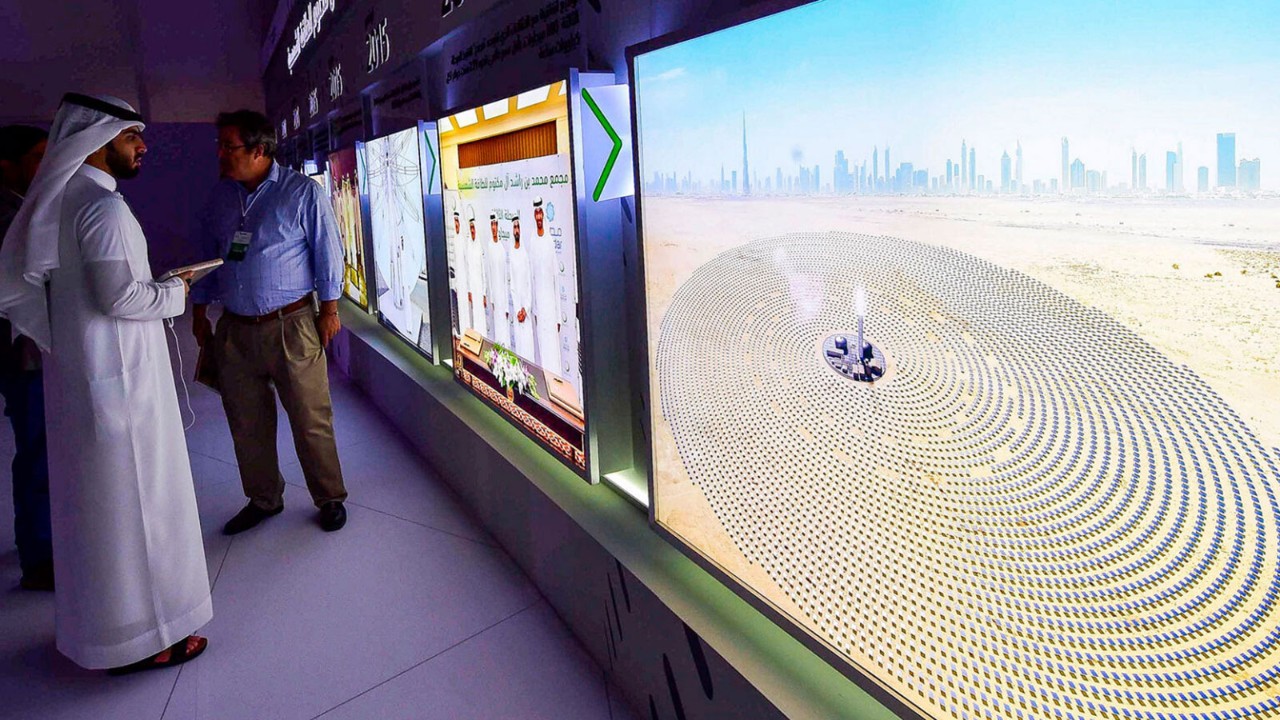
The Middle East is one of the few regions capable of meeting the world’s expanding energy needs in the age of AI. The region offers what AI infrastructure requires: abundant traditional energy through oil and gas, rapidly expanding renewable capacity through mega projects such as the huge Mohammed bin Rashid solar park in Dubai, Masdar’s global renewables portfolio and Saudi Arabia’s Sudair solar plant, as well as rising nuclear capability led by the UAE’s Barakah nuclear power station. Few regions can deliver all three pillars at scale.
Equally important, Gulf producers have built deep expertise in supplying large volumes of energy with some of the world’s lowest production-related emissions. They have pursued methane reduction, electrification, carbon capture and strict efficiency standards for years. For example, Adnoc, one of the world’s largest energy producers, is lowering its emissions intensity through clean electricity use, large-scale carbon capture and methane reduction, while also integrating AI to improve efficiency and reduce operational emissions even further.
There is no longer space to decarbonise before development begins
Combined with vast solar potential, long-term grid planning and strong investment environments, the Middle East is clearly positioning itself as the ideal location to host the next generation of AI mega clusters.
An unavoidable truth
AI is forcing the world to accept an unavoidable truth. Development and decarbonisation must happen at the same time. There is no longer space for a staged process in which one finishes before the other begins. The Middle East is advancing a model that reflects this reality, one based on scaling renewables, maintaining reliable gas, building nuclear capacity and lowering emissions across existing systems.
This approach is not ideological. It is practical, integrated and aligned with the direction global demand is moving. It offers a blueprint for powering economic growth and reducing emissions in parallel rather than in conflict. As the world moves deeper into the age of AI, that balance will define which regions lead and which fall behind.

