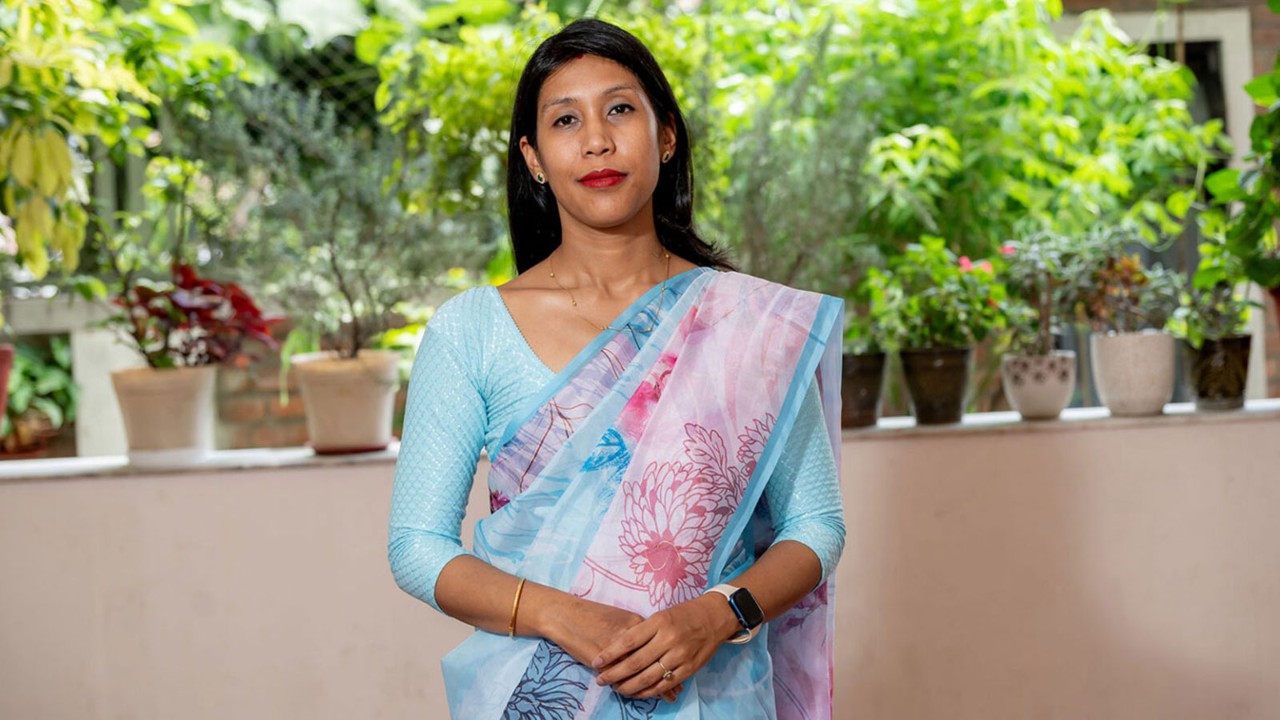
For Priyanjali Joshi, ethical practice lies at the heart of both compliance and sustainability, and has always been part of her life.
The compliance manager at Local Initiatives for Biodiversity, Research and Development (LI-BIRD) hails from Nepal’s second city, Pokhara, in the foothills of the Himalayas. Her childhood, surrounded by the mountains, rivers and lakes, shaped her views about the vital energy of the environment she grew up in and inspired her to give back to society.
‘We cannot be like “I’m a finance professional, and need only know the numbers”’
As a student, she recalls finance professionals being dismissed as people who ‘work only on balance sheets’, and is convinced that, in a world where tech and AI are now dominant, professionals need to ‘give the human touch in everything they do’.
She adds that cross-sector knowledge is essential to remain relevant in today’s financial landscape. ‘We cannot be like “I’m a finance professional, and I need to only know the numbers.”’
Building accountability
After finishing her studies, Joshi joined PP Pradhan, one of Kathmandu’s leading audit firms, and gained valuable exposure to the non-profit sector. ‘It wasn’t just the balance sheet,’ she adds. ‘I was drawn to goals that organisations were working towards at grassroots levels to transform the lives of marginalised and vulnerable communities.’ So when she saw an opening for a finance officer at LI-BIRD, she jumped at the chance.
With more than a decade at LI-BIRD now under her belt, she says that treating ‘compliance as a checklist’ is a woeful strategy. Compliance, she argues, goes beyond rules and regulations, and involves adhering to ethical practices. For an organisation like LI-BIRD, which operates in the biodiversity, sustainable agriculture and climate resilience space, it ensures accountability – the very core of the accountant’s role – and all the benefits that flow from that.
‘When each rupee or dollar is accounted for, it creates a sense of trust and ownership’
Good governance, she says, is the ‘heart of sustainability’ and key to turning a temporary project intervention into long-term impactful work. ‘Transparency is crucial in a world where we can easily be deflected from the truth. When people, government and our beneficiaries believe that each rupee or dollar is accounted for, it creates a sense of trust and long-term institutional viability and ownership. That trust can only develop if we are compliant with national and global regulations.’
In short, compliance helps funders, local communities and governments to see LI-BIRD as a dependable bridge for supporting communities.
LI-BIRD
Founded in 1995, Local Initiatives for Biodiversity, Research and Development (LI-BIRD) is a non-profit, non-governmental organisation striving to uplift the livelihoods and strengthen climate resilience of rural communities across Nepal. Its work spans agriculture, climate change adaptation, biodiversity and natural resources.
Beginnings
Joshi early audit experience informs her work in advancing sustainability and good governance. Among the many insights she gained from her seniors at PP Pradhan is that ‘auditing is not just a year-end task, but an opportunity for an organisation to grow’.
‘Amid funding uncertainties, donor trust earned through impact and accountability has provided a better space for LI-BIRD’

The transition to LI-BIRD has been an enriching experience. She says: ‘What hit me was that I wasn’t the one just pointing out mistakes any more.’ Instead, she was using information to take a ‘proactive approach rather than a retrospective lens to build a robust system’ and find ways to overcome any shortcomings she identified.
Her rigorous assessments, reviews and feedback have helped LI-BIRD to build trust with long-term funders, some of whom have been supported its projects for the past 16 years. Joshi says LI-BIRD is also developing policies and implementing frameworks that are still new to Nepal’s non-profit sector. ‘Amid funding uncertainties, donor trust earned through impact and accountability has provided a better space for LI-BIRD.’
Funding challenges
But compliance comes with challenges. Too lengthy a must-do list can be beyond the capacity of many grassroots organisations to satisfy. Other roadblocks include regulatory changes by funding agencies, co-financing through multiple funders, and funders’ failure to cover institutional costs.
‘No profit is made in the sector, so we cannot create a reserve amount,’ Joshi points out. What’s more, there is significant competition all over the world for grant funding, which makes writing winning proposals a significant burden.
It is no longer enough for non-profits like LI-BIRD to be given a ‘list of things they have to do’, she says; they also have to understand ‘the why behind it’. She adds: ‘If sustainability reporting standards are made compulsory, grassroots organisations should be able to understand why they are introduced and why adhering to them is important.’
While regulatory authorities in Nepal provide training and workshops when new reporting standards are in place, they need to ensure that the support reaches beyond the big cities. ‘Executing this knowledge is the most critical step,’ she says.
‘Capacity building allows a project to run on after the institution has exited’
Empowering communities
On sustainable transformation, Joshi says it is important to build the capacity of people. ‘Once an institutional figure leaves a project, the project runs on its own. Capacity building means when we uplift a community, it can continue for the long run.’
During the early stages of its projects, LI-BIRD also onboards local governments, which creates ‘a sense of ownership’. She explains how authorities have taken responsibility for a successful home garden initiative launched by the non-profit across Nepal.
Meanwhile the 33-year-old mother of two now frequently travels to rural areas across Nepal. ‘It gives a sense of fulfilment when I see that our little work is able to bring significant changes,’ she says. ‘Mothers tell me that they can now feed their kids and send their little girls to school.’
CV
2015
Finance officer, then compliance manager, LI-BIRD, Nepal
2012
Audit trainee, then audit senior, PP Pradhan, Nepal


