
The ACCA Hong Kong Annual Conference 2026, themed Leading Through Volatility: Hong Kong 2026 and Beyond, convened government officials, senior finance leaders, C-suite executives, academics and accounting professionals for a day of high-level dialogue.
Against a backdrop of geopolitical tensions, uneven post-inflation recoveries and rapid AI-driven disruption, the conference explored how Hong Kong SAR of China – an open, connected economy at the crossroads of international flows – can navigate complexity and convert uncertainty into new possibilities.
Cautious but constructive
In his keynote speech, Patrick Ho, chief investment officer for North Asia at HSBC Private Bank and Premier Wealth, noted that markets have delivered strong returns even as the macro environment remains fragile.
‘Despite the volatility we’ve seen, investment markets have grown significantly, largely because technology companies now make up such a huge portion,’ Ho said. But when returns concentrate so heavily in tech, it raises questions about how broad-based and resilient those gains really are, he added.
‘Productivity gains from AI are already showing up in the data’
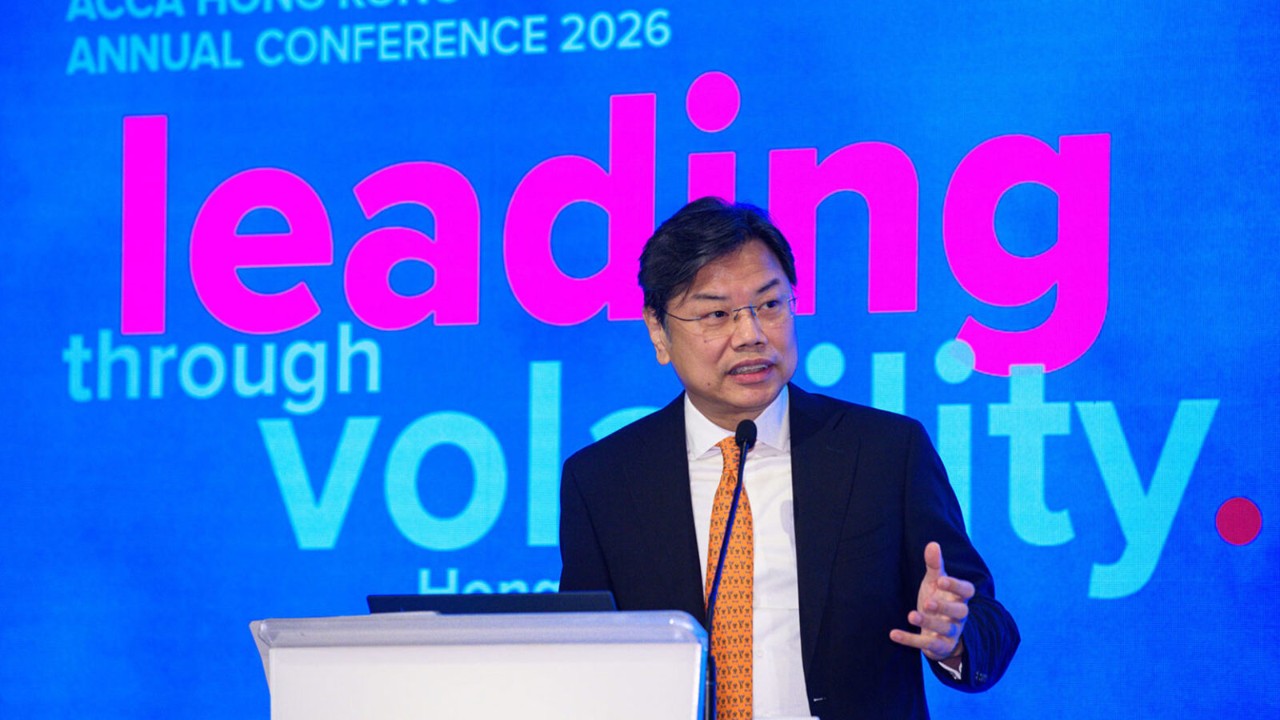
On geopolitical risk, Ho acknowledged the toll of the Middle East conflict but argued that its economic impact has, so far, been manageable. ‘Oil-price volatility undoubtedly affects livelihoods, but it’s been within the range of expectations,’ he noted. ‘Where we are now is a picture of slowing growth, rising inflation and stable rate policy.’
Ho struck a more optimistic note on AI, pointing out that ‘productivity gains from AI are already showing up in the data’, and that the fundamentals and infrastructure supporting AI investment remain strong.
Global forces
Even as competition between major economies, including the Chinese mainland, the EU and the US, intensifies, Ho said that all parties are chasing the same priorities: energy independence, AI leadership and access to critical resources. That convergence, he suggested, points to durable investment opportunities: ‘Regardless of which side gains the upper hand, capital will keep flowing into these areas.’
Still, he urged investors to stay disciplined. ‘Policy uncertainty is elevated, but markets don’t react to every headline anymore. Neither should investors.’ He advised investors to ‘diversify your diversifiers’, spanning bonds, hedge funds, and public and private credit.
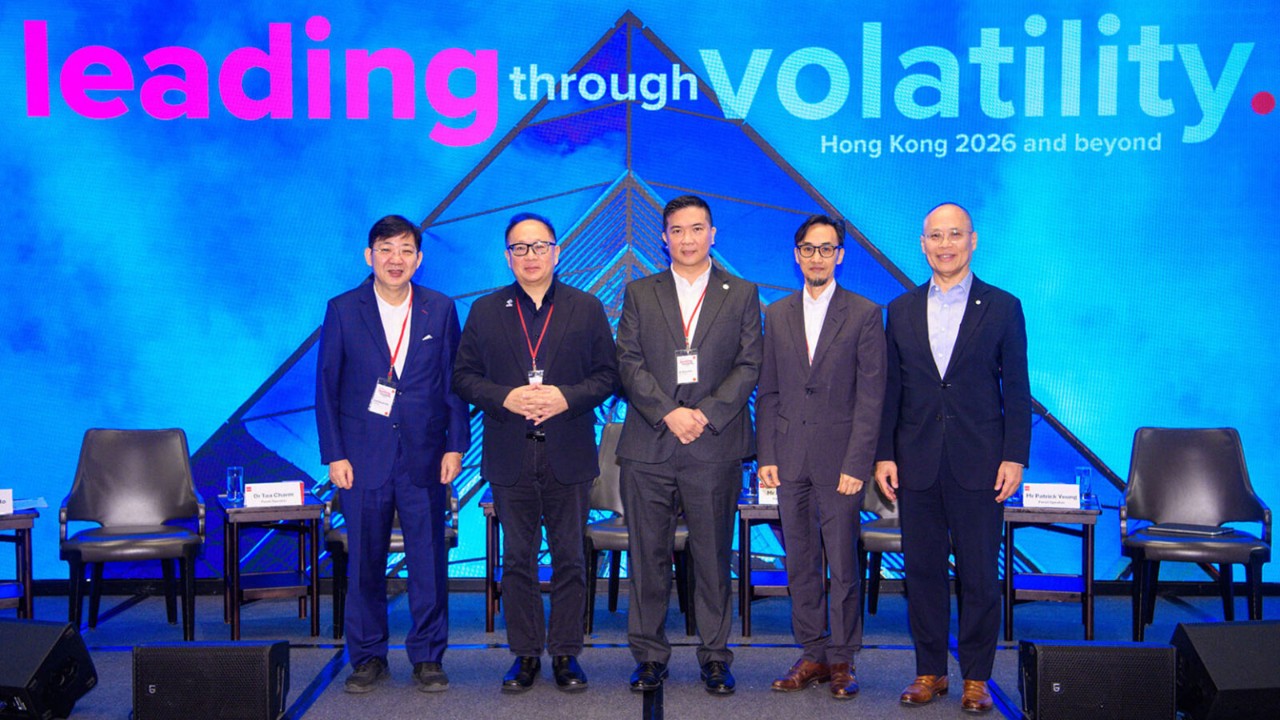
Professor Simon Ho, president of The Hang Seng University of Hong Kong, moderated a panel discussion that widened the lens to examine how trade wars, supply-chain reconfigurations, technological disruption and the spectre of an AI investment bubble are converging on Hong Kong SAR.
Professor Ho set the frame early, noting that while AI can ‘personalise services, raise productivity and bring added value’, it carries significant risks, such as cybersecurity and data control. That duality – immense promise tempered by real vulnerability – became a recurring theme across the panel.
AI: enabler or bubble?
Dr Toa Charm, founding chairman of the Data & AI Literacy Association, argued that AI technology is already ‘driving economic development and fuelling the data centre boom’, but stressed that deploying it responsibly requires more than capital. ‘You need data, algorithms and people to deploy AI on the ground. It involves change and, internally, there can be many barriers,’ Charm said.
‘Top executives increasingly expect AI to deliver cost savings and competitive advantages, yet its success still hinges on effective people and change management,’ he added.
‘AI’s success still hinges on effective people and change management’
For the accounting profession specifically, he urged ACCA members to strengthen AI governance and adopt a ‘human-in-the-loop’ model that keeps professional judgment at the centre. The AI-first companies leading the way, he added, are those that ‘encourage staff to use AI in every task’, not as a replacement for people but as an embedded tool across workflows.
Bruno Lee, founder of BIG Family Limited, weighed in from an investment perspective. ‘In broad strokes, investors are taking a wait-and-see attitude because of the war, AI disruption, interest rates and trade tensions,’ he said. While AI-related capital spending is booming – concentrated heavily in data centre infrastructure – Lee urged the audience not to get swept up in the hype.
‘We need to think of AI as an enabler for the essentials: food, clothing, shelter and transportation. AI can’t provide these things to us directly, but it can improve efficiency, save costs and increase competitiveness,’ said Lee.
Supply-chain shifts
Henry Ho, CFO at Plaza Premium Group, brought the conversation down to the operational frontline. Having steered the company through Covid-19 and now the Middle East conflict, he delved into the tangible effects of geopolitical disruption. ‘Flight volumes on Middle East routes dropped by 50%, but they built back up shortly after,’ he said.
The conflict has redirected travel patterns, with more passengers transiting through Hong Kong SAR, creating short-term upside for the airport and hospitality sectors. But Ho cautioned against overstating the windfall, as rising oil prices and longer flight times are pushing costs higher. ‘Long-term sustainable growth still depends on Hong Kong’s infrastructure and its positioning as a world-class events hub,’ he said.
Patrick Yeung, CEO at The Hong Kong General Chamber of Commerce, stressed that supply chain reconfiguration tops the business community’s concerns. ‘The fact that global supply chains are being reconfigured is what matters most to our HKGCC members,’ Yeung said.
He pointed to encouraging signs – Middle East capital flowing into Hong Kong SAR and new opportunities opening in Central Asian markets – but kept his advice pragmatic: ‘Businesses are best positioned if they broaden their income sources and reduce expenditure.’
More information
Register to access the on-demand ACCA Hong Kong Annual Conference 2026


