
Five people have just finished their meal at a pizzeria, and the waiter comes along with a bill for £82.
What happens next? Invariably, the group looks around for the ‘maths person’ among them, in the hope that he or she will work it out. If I’m one of the group, that person is usually me. And if you’re an accountant, I bet it’s normally you.
You need to have a sense of whether a number ‘feels right’
The widely shared view nowadays is that arithmetic can be left to somebody else. After all, even if there’s no handy maths person to do it, then thanks to the mobile phone we all have a calculator literally to hand almost all the time.
Yet despite the ubiquitous calculator, I want to argue that the ability to do basic mental arithmetic is as important and valuable today as it’s ever been. Why? Because when a calculator, spreadsheet or ChatGPT produces an answer, you need to have a sense of whether the number ‘feels right’ – and you can only do that if you can do simple arithmetic.
Suspicious spreadsheets
Here’s an example. Imagine a small company has produced a spreadsheet (shown below), listing the sales of widgets in column B, and the total at the bottom in row 9.
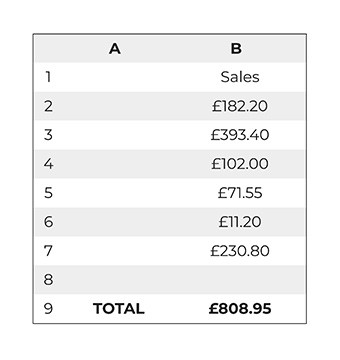
Look at that total. Does it feel right to you? If not, that can only be because you’ve done a quick estimate. Round the numbers to the nearest hundred and the total will be roughly £200 + £400 + £100 + £100 + £0 + £200, which makes £1,000. That’s a long way from £808.95, so something feels wrong. And sure enough, the formula in cell B9 is: SUM(B3..B7). Cell B2 should also be included in the formula but has been missed out. The correct total should be £991.15. Mistakes like this are all too common in spreadsheets.
It looks tricky – but only until you realise you can swap the numbers round
Don’t get me wrong: if you want a precise answer to a calculation with tricky numbers, then calculators and spreadsheets are the way to go. But if you want confidence in those numbers, it’s essential to be able to do basic addition and subtraction in your head, and to know your times tables.
Tricks and shortcuts
Mental arithmetic is useful for more than simply spotting mistakes. If you have a head for figures, there are all sorts of tricks and shortcuts that can help you tap into the power of numbers. Here are two of my favourites.
16% of 25. You probably have to calculate percentages like this all the time, and 16% of 25 looks tricky – but only until you realise that in ‘percentage of’ calculations you can swap the numbers round.
16% of 25 is the same as 25% of 16, which is a quarter of 16, which is 4. Easy!
Why does it work? Because whenever you multiply two numbers, the order doesn’t matter. A x B is the same as B x A. In this case you’re working out 16 x 25, which is the same as 25 x 16, and then dividing by 100 (which is all that ‘percentage’ means).
The Rule of 72. Suppose you have an investment that is growing at 4% per year, compound interest. How long will it take to double in value? Exponential growth can be complicated, and you might be expecting to need logarithms here. But the Rule of 72 says that the time taken to double is simply 72 divided by the growth rate, in this case 72/4 = 18, so it will take 18 years. This is only an approximation but it is remarkably accurate for percentages in the range 1%–10%.
Split the bill
Finally, remember those five people sharing the pizza bill? There’s a handy trick that I often use when dividing by a bill by five. Instead of fiddly division, you just double and then divide by 10. So a bill for £82 shared between five people will be: 82 x 2 = 164, then divide by 10, which is £16.40.
Mental arithmetic helps to keep your brain fit. As a bonus, your easily impressed friends might regard you as some sort of mathematical genius.


