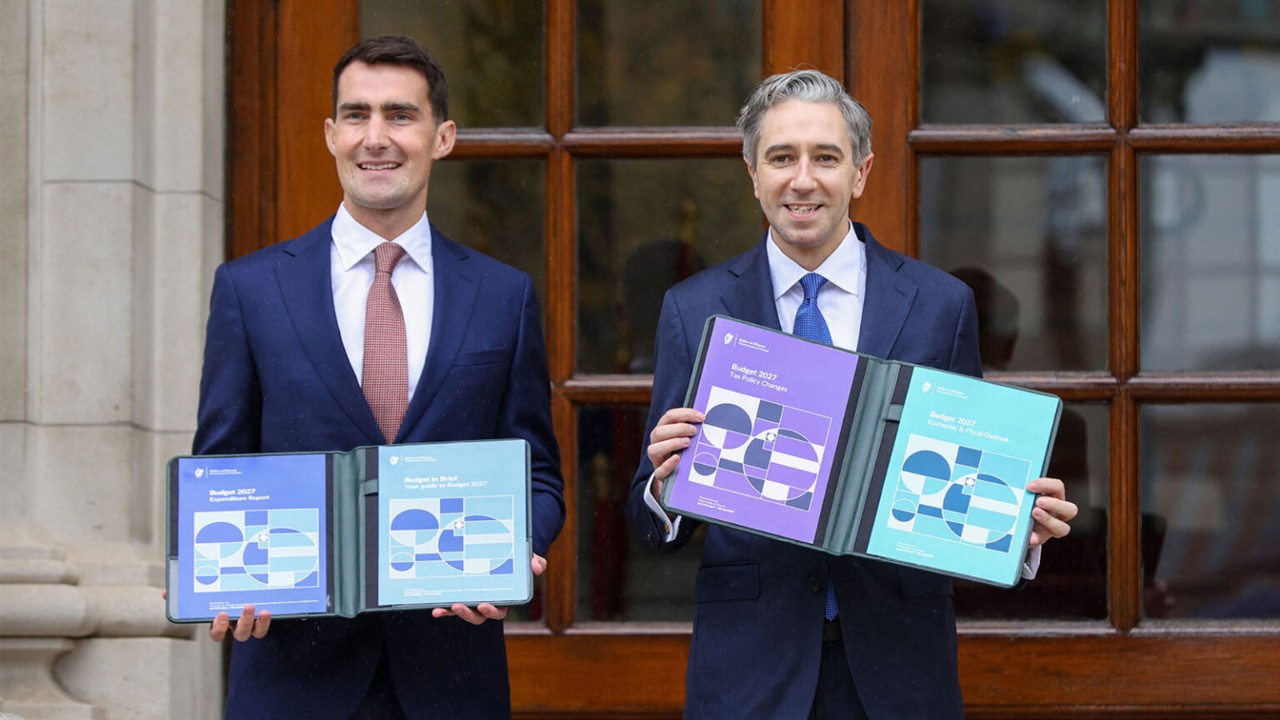
The Irish Government presented Budget 2027 on 6 October 2026, calling it a ‘budget for workers’. As well several measures affecting investors, entrepreneurs and businesses, it also aimed to address the public unease over the lack of movement on personal tax in last year’s budget.
Investment and business
From 1 January 2027, the tax rate applying to Irish and certain equivalent offshore funds and life assurance products falls to 35%. A new Investment Account is planned from 1 July 2027, with a €50,000 tax-free threshold, a 1% annual charge on amounts above that threshold and a €12,000 annual contribution limit. The measures are intended to encourage greater participation by individuals in long-term investment.
For companies undertaking qualifying research and development, the R&D tax credit first-year payment threshold will rise to €105,000. The Budget also provides for enhanced rules relating to qualifying outsourced research expenditure.
The standard capital gains tax rate will fall from 33% to 31% for disposals from 7 October 2026. Development land remains subject to the 33% rate. The reduction is therefore significant for individuals and businesses disposing of chargeable assets outside the development land rules.
For gifts and inheritances taken from 7 October 2026, capital acquisitions tax (CAT) increases to €420,000 for Group A, €44,000 for Group B and €22,000 for Group C. The higher thresholds increase the amount that can pass between qualifying beneficiaries before CAT becomes payable.
The Budget indicated plans to extend business reliefs related to Knowledge Development Box and other investor reliefs. The Finance Act will contain the detailed provisions.
Climate and energy
Climate and motoring measures continue to use the tax system to influence energy and vehicle choices, although the public unease at increasing energy costs also pushed policymakers.
Budget 2027 reduces the carbon tax on kerosene/home heating oil and natural gas to €48.50 per tonne. The scheduled increase for auto fuels is deferred to 1 May 2027, with other scheduled fuel increases also deferred or rephased. This aims to soften the immediate cost impact on households and motorists of the recent increase in energy costs.
The minimum wage has risen over 60% in the last 10 years and at a greater rate than general wage rates
The €5,000 VRT relief for electric vehicles will run until 31 December 2028. At the same time, VRT rates for higher emission vehicles will rise, alongside changes to carbon tax and fuel excise, maintaining the broader policy direction of favouring lower emission transport.
Costs of living and housing
The government outlined several measures intended to support households.
From 1 January 2027, the minimum wage rises from €14.15 to €14.94 per hour. There is also a related change in the PRSI and USC thresholds to ensure the higher minimum wage remains at the lower employer PRSI and USC rates. This increase means that the minimum wage has risen over 60% in the last 10 years and at a greater rate than general wage rates.
The rent tax credit increases by €150 to €1,150 for a single claimant and €2,300 for a jointly assessed couple for 2027 and 2028. By contrast, the mortgage interest tax credit is due to expire at the end of 2026 and was not extended in Budget 2027.
The rent-a-room relief increased to €16,000 per annum, and the relief was extended to certain auxiliary structures outside of the home.
Although the economy is strong, the tax base remains highly concentrated
A new derelict property tax (DPT), administered by Revenue, will apply at 7% of the self-assessed value of residential and non-residential properties on local authority derelict property registers. Preliminary registers are due from September 2027, with the first pay and file deadline in June 2028.
From 1 January 2027, the standard income tax band rises to €46,500 for single persons and €55,500 for one-income married couples or civil partners. The single personal, employee and earned income tax credits each rise to €2,125. Together, these changes provide modest income tax relief to employees and the self-employed.
The maximum help-to-buy relief increases from €30,000 to €35,000 for qualifying claims from 7 October 2026.
Warnings
The Irish economy remains strong and, although the government was able to forecast a €9.5bn surplus for 2027, the tax base remains highly concentrated. Recent Revenue and Irish Fiscal Advisory Council data underline this fiscal risk:
- Foreign owned multinationals pay 87% of corporation tax, while the top three US multinationals contribute nearly half of the total collected.
- The top 20% of taxpayers account for about 80% of the projected personal income tax yield, illustrating a similar concentration within the personal tax base.
The 2027 Budget offers useful relief to many businesses and households, but its longer-term success will depend on whether it supports sustainable growth, broadens the tax base and strengthens the resilience of the public finances.
More information
Find out more about the Budget

