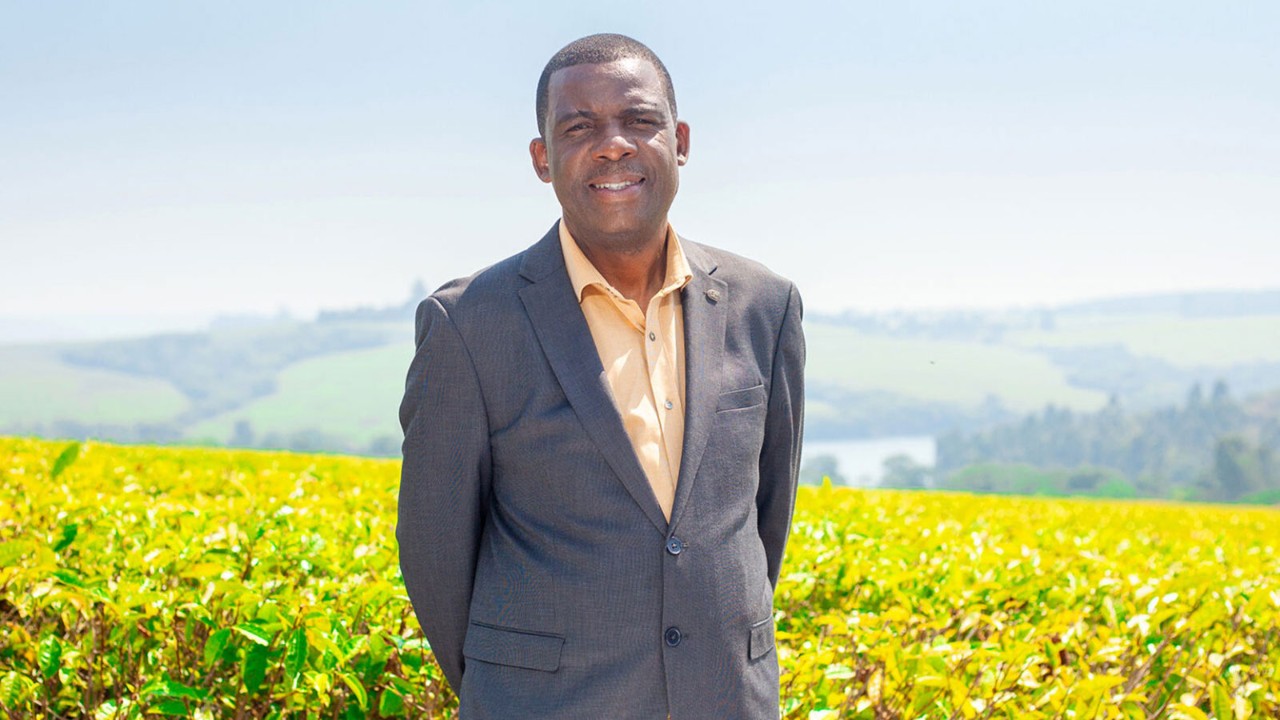
Tanganda Tea, the largest grower of tea and coffee in Zimbabwe, celebrated its 100th birthday in 2024. But as its finance director Henry Nemaire FCCA – who has worked for the company for a quarter of its existence – points out, environmental and economic necessity has shaped the company into something that its founders would barely recognise.
‘For decades, Tanganda was a single-crop company. When I joined, we were growing 2,400 hectares of tea,’ says Nemaire. ‘But the tea harvest runs from September to April, which is a short window that makes cashflow a challenge.’
‘It was a viability issue; we had to climate-proof’
Diversification was an obvious strategy, initially to create year-round revenues, but in recent years climate change and fluctuating commodity prices have made it an imperative. ‘We realised we couldn’t sustain the company as it was,’ says Nemaire. ‘It was a viability issue; we had to climate-proof.’
Economic protection
Today, Tanganda is the biggest grower in Zimbabwe of macadamia nuts (900 hectares), tea (2,000+ hectares) and avocados (550 hectares) and also grows coffee (200 hectares) at its five estates in the Chipinge district, on the border with Mozambique. ‘We began developing macadamia nuts from about 2005 and accelerated the diversification from 2010, moving into avocados,’ says Nemaire. The only thing stopping further expansion is a lack of land – so the company is exploring third-party joint ventures with local farmers.
The variety of crops provides economic protection from changing weather patterns, particularly long, dry spells and the increasing frequency of cyclones; heavy rainfall from cyclones in 2019, 2020 and 2021 triggered flooding across parts of Zimbabwe.
CV
2010
Finance director and company secretary, Tanganda Tea Company, Harare, Zimbabwe
2000
Chief internal auditor, Tanganda Tea Company, Mutare, Zimbabwe
1999
Financial accountant, PG Zimboard, Mutare
1998
Senior accountant, Lonrho Agribusiness, Mutare
1997
Consultant, EY, Mutare
1994
Articles of clerkship, Deloitte, Mutare
‘Cyclones have the biggest impact on the avocado crop, especially if there is hail, and a lesser impact on macadamias,’ he says. ‘But tea bushes tend to thrive in those conditions because it’s a hardy bush that can sustain high winds and it likes water. When we have hot, dry spells, it has generally affected the tea crop more than avocados and macadamias because we irrigate the latter.’
Solar investment
The large tea plantations have historically been too expensive to irrigate, but in the next five years Tanganda plans to invest US$2.4m in laying tea irrigation infrastructure that will utilise its investment in solar, says Nemaire. ‘This should climate-proof our tea production in future.’
The company’s beverage division includes a tea blending and packaging plant in Mutare and sales and distribution depots across the country. The agricultural division meanwhile is focused on further adding value to the company’s products, with bottling of spring water and extraction of oil from secondary-grade avocados taking place in Chipinge.
‘At one point, prices were going up by 98% every day’
Changing consumer tastes worldwide are creating an attractive market for Tanganda’s products. The global macadamia nut market, for example, is worth around US$1.5bn today and projected to reach almost US$7bn by 2030, while the avocado market is worth an estimated US$20bn. But commodity prices are unpredictable: for example, the price of both avocados and macadamia nuts fell sharply during the pandemic and while both have recently firmed, they remain well below pre-Covid levels.
Extreme environment
The biggest shadow for any business in Zimbabwe, though, is inflation.
Tanganda has weathered three lengthy seasons of hyperinflation since Nemaire joined the company: between 2001 and 2008 when inflation reached over 79 billion percent a month; in 2019 when the Zimbabwe dollar was reintroduced; and again from 2022. For most of 2025, the annual inflation rate has hovered around 80%. ‘Companies that are reporting in our local currency have not been permitted yet to come out of IAS 29, so we are still technically in hyperinflation,’ says Nemaire.
Tanganda Tea in numbers
US$25.8m
Revenue in 2024
US$1.4m
Profit in 2025
8,113 tonnes
Quantity of tea produced (2024)
76%
Percentage of tea exported (2024)
3,976 tonnes
Avocados produced (2024)
1,626 tonnes
Macadamia nuts produced (2024)
It’s enough to give accountants in any other country the chills, but as Nemaire points out, this is everyday life for Zimbabwe. ‘It’s a tough environment and you have to stay on your toes all the time,’ he says. ‘When you talk to people in stable economies they don’t understand – at one point, prices were going up by 98% every day.’
Maintaining stability
His priority as finance director is to make sure that money is kept in a stable currency and that payments are closely managed. ‘There is a lot of juggling, and suppliers want their payments upfront; there are no credit terms. It’s a rollercoaster.’
Operating in this environment also means producing three different sets of accounts. ‘We produce historical accounts, and then management accounts in a stable currency – the US dollar in our case – which are used for decision-making. Then we also produce statutory IAS 29 hyperinflation-adjusted accounts. All three sets of accounts go to the board.’
‘If you need to know anything about IAS 29, this is where you need to come’
This process creates a lot of work for the 17-strong finance team – which is less than half the size of the one Nemaire inherited in 2000. ‘That’s something I’m very proud of,’ he says. ‘We have become a leaner and much more efficient team.’
As a finance team, and a finance director, they are not easily fazed. As Nemaire points out, hyperinflation has been around for so long in Zimbabwe that accountants know exactly what they need to do; on the rare occasions when the company’s external auditors have raised questions, he adds, it is inevitably a misunderstanding by someone based outside of the country.
‘Zimbabwe has got the experience and the skills to deal with hyperinflation,’ he says. ‘If you need to know anything about IAS 29, this is where you need to come. We are the world’s experts.’


