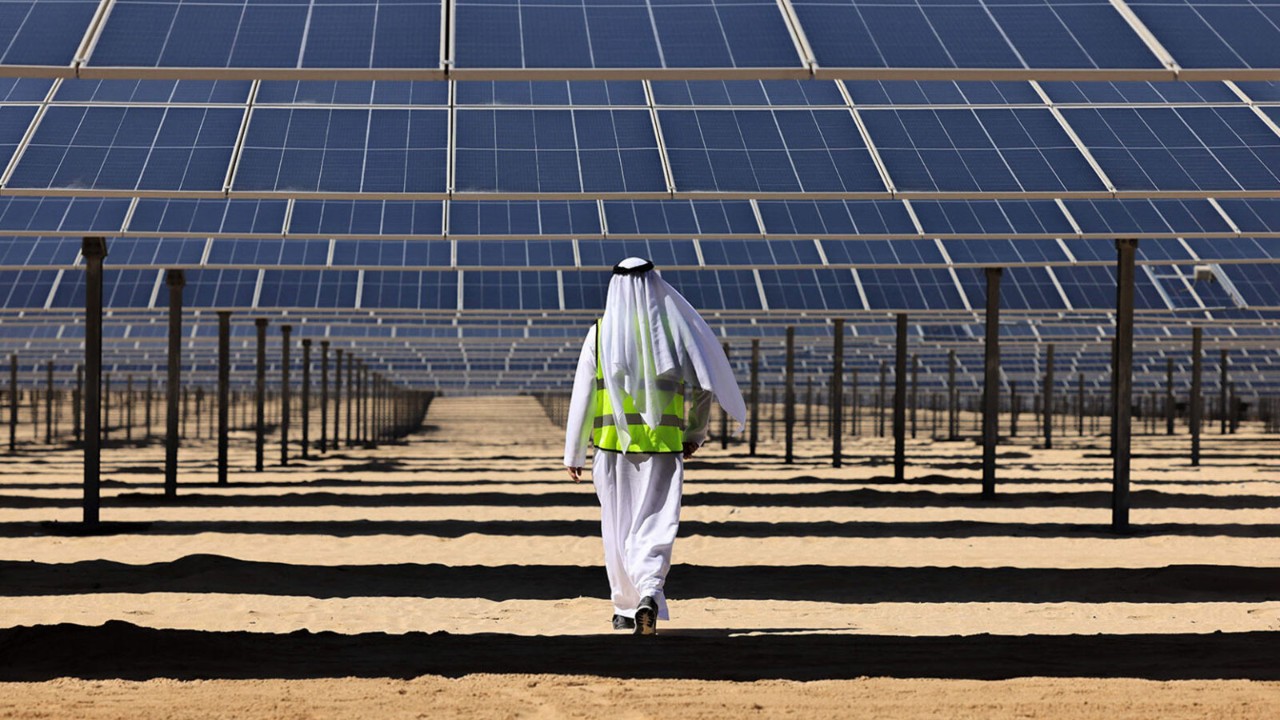
Across the Gulf, climate pledges are moving from press conferences to balance sheets. Strategy& estimates that the Gulf Cooperation Council’s (GCC) sustainability transition, from clean power and hydrogen to low-carbon industry and circular-economy infrastructure, could generate up to US$2 trillion in economic value by 2030.
That scale has shifted the conversation. The question is not whether the region is committed to the transition, but how fast it can build the market architecture and trust needed to attract global capital at scale.
In a market where many projects are still at the planning stage, one group has become central to making this transformation bankable: accountants and assurance professionals – the technical referees behind sustainability claims.
‘My teams focus on setting realistic baselines from day one’
The stakes are high. COP28 accelerated regulatory expectations, the UAE and Saudi Arabia are rolling out sustainability disclosure frameworks, and regional exchanges are moving gradually toward mandatory climate reporting. The ambition is clear – now comes the execution.
What investors want is simple: money follows proof. Capital providers will fund green projects if issuers can show where proceeds will go and how results will be measured – and that makes accountants, auditors and specialised advisers the backbone of the GCC’s green-finance ecosystem.
Data discipline
The Gulf’s green transition is defined by speed. Projects often reach financing conversations while still on the drawing board, which means data discipline from the start.
Monaem Ben Lellahom, group CEO and co-founder of ESG consultants Sustainability Square, explains that much of the work in the region happens before capital is raised. ‘My teams focus on setting realistic baselines, validating assumptions and ensuring a traceable data system is in place from day one so that when assets come online, the reporting foundation already exists,’ he says.
‘Investors price trajectory, not aspiration’
He has also seen lenders and development financiers push for third-party validation earlier in the process, signalling a market evolving toward evidence over narrative. For him, advisers and accountants are complementary actors: advisers design the frameworks and identify key performance indicators (KPIs); assurance professionals test and verify what is ultimately disclosed. ‘When that sequence works, companies arrive to market with an investor-ready story grounded in facts rather than presentation,’ he says.
Future clarity
At the early ‘go/no-go’ moment for green instruments, credibility rests not on past performance but on future clarity. Kabir Dhawan, partner – consulting at Grant Thornton, explains that, at this point, professionals are validating the strength of the plan itself: ‘The task is to evaluate whether proposed sustainability-linked KPIs genuinely reflect the core operations, whether they are measurable over time and whether the projects tied to green-bond proceeds are clearly defined and capable of being reported on.’
Samer Hijazi, partner and head of financial services audit at Grant Thornton, notes that the Gulf’s biggest adjustment has been bringing non-financial information up to the standards traditionally applied to financial reporting: ‘That means reliable baselines, internal controls that can withstand audit scrutiny and disclosures structured in ways that international markets recognise.’
‘Regulators across the Gulf are nudging the market forward’
In industries such as energy, heavy manufacturing and logistics, areas central to Gulf economies, investors do not necessarily expect perfection, but they do expect clarity, consistency and credible pathways. ‘Investors price trajectory, not aspiration,’ Hijazi says.
From the vantage point of Rashid Khursheed, partner and sustainability assurance leader, and Shubham Bhandari, director, at PwC Middle East, the region is seeing accountants pulled into transactions earlier than before. ‘At framework stage, third-party opinions remain the main tool to evaluate design, governance and eligibility,’ says Bhandari, ‘while accountants validate any disclosed financial information and assess whether the reporting environment is built well enough to support assurance when the time comes.’
The most common refinements in GCC deals relate to the precision of emissions data, the specificity and time-bound nature of KPIs, the readiness of internal controls for ESG metrics and the alignment of frameworks with international benchmarks. ‘Regulators across the Gulf are nudging the market forward, encouraging issuers to adopt consistent disclosure practices and building investor confidence in the region’s sustainability pipeline,’ says Khursheed.
Credibility gatekeepers
Banks are emerging as powerful arbiters of what qualifies as ‘green’. Vijay Bains, group chief sustainability officer at Emirates NBD, explains that the bank relies on its internal sustainable finance framework and specialist teams to screen transactions. Independent second-party opinions remain common for larger deals, but internal evaluation is central.
‘Confidence comes not from promises but from delivery’
Scrutiny does not end once funds are disbursed. Performance is monitored and sustainability classifications can be delayed, adjusted or removed if reporting falls short or KPIs are not met. ‘Confidence comes not from promises but from delivery,’ says Bains, adding that the bank is seeing steady improvement in both issuer frameworks and reporting practices.
The Gulf’s sustainability financing is maturing in real time, shaped by systems, controls and assurances that make capital comfortable. Projects that can demonstrate reliable baselines, measurable KPIs and internationally recognisable disclosure structures are moving faster and pricing better. Those that cannot are learning quickly what investors expect. The ability to present verifiable, comparable and audit-ready data has become a competitive advantage.
The region enters this transition from a position of strength: sovereign wealth capital, proven megaproject execution capability and increasingly sophisticated financial markets. But the success of the region’s green-finance ambitions will depend on discipline.
In the end, the Gulf’s most impactful sustainability work may come not from the projects that dominate headlines, but from the accountants, auditors and advisers who ensure that those projects can withstand scrutiny. If the GCC succeeds in mobilising the full scale of its green-finance opportunity, it will be because ambition was matched with verification and because credibility became a competitive advantage in its own right.