
The ACCA Hong Kong Annual Conference 2026, themed ‘Leading Through Volatility: Hong Kong 2026 and Beyond,’ brought together government officials, finance leaders, C-suite executives, academics and accounting professionals for a day of high-level dialogue on how Hong Kong SAR of China can navigate global uncertainty and seize new opportunities.
A closing panel discussion, moderated by former TV news reporter Bonnie Ng, turned the spotlight on the Special Administrative Region’s domestic transformation. ‘How can innovation, technology and research power growth?’ she asked, setting the stage for a conversation on evolving growth engines.
A dual-engine city
Hong Kong SAR’s economy is riding on strong momentum. Robust expansion in the first quarter of 2026 saw real GDP growing at 5.9% year on year, while full-year GDP growth hit 3.5% in 2025. But the panel’s focus was less on the current numbers than on whether Hong Kong SAR is building the right structural foundations for the next decade.
‘Hong Kong is a combination of Wall Street and Silicon Valley’
‘Hong Kong has a unique position as both an international financial centre and part of the Greater Bay Area. It’s a combination of Wall Street and Silicon Valley,’ said Wilfred Yiu, former deputy CEO of Hong Kong Exchanges and Clearing (HKEX). The financial pillar, in his view, remains powerful. ‘If you’re a global company, listing in Hong Kong gives you access to mainland China capital. That’s one of a kind in the world.’
According to Boston Consulting Group’s 2026 Global Wealth Report, Hong Kong SAR now manages roughly US$2.95 trillion in cross-border wealth, edging past Switzerland’s US$2.94 trillion to claim the top spot globally.
It’s a milestone that Daniel Jim, managing director of Chartwell Capital, highlighted during the discussion. ‘Hong Kong officially overtook Switzerland to become the world’s largest cross-border wealth booking centre,’ he said. ‘But more importantly, we need to think about how we can mobilise that capital.’
Innovation launchpad
China’s 15th five-year plan designates the Guangdong-Hong Kong-Macao Greater Bay Area as one of the country’s three primary engines of high-quality development. Hong Kong SAR’s buildout as an international hub for eight sectors – finance, trade, shipping, aviation, intellectual property trading, legal services, cultural exchange, and innovation/technology – aligns directly with the plan’s strategic pillars.
‘We need the private sector too to drive innovation’
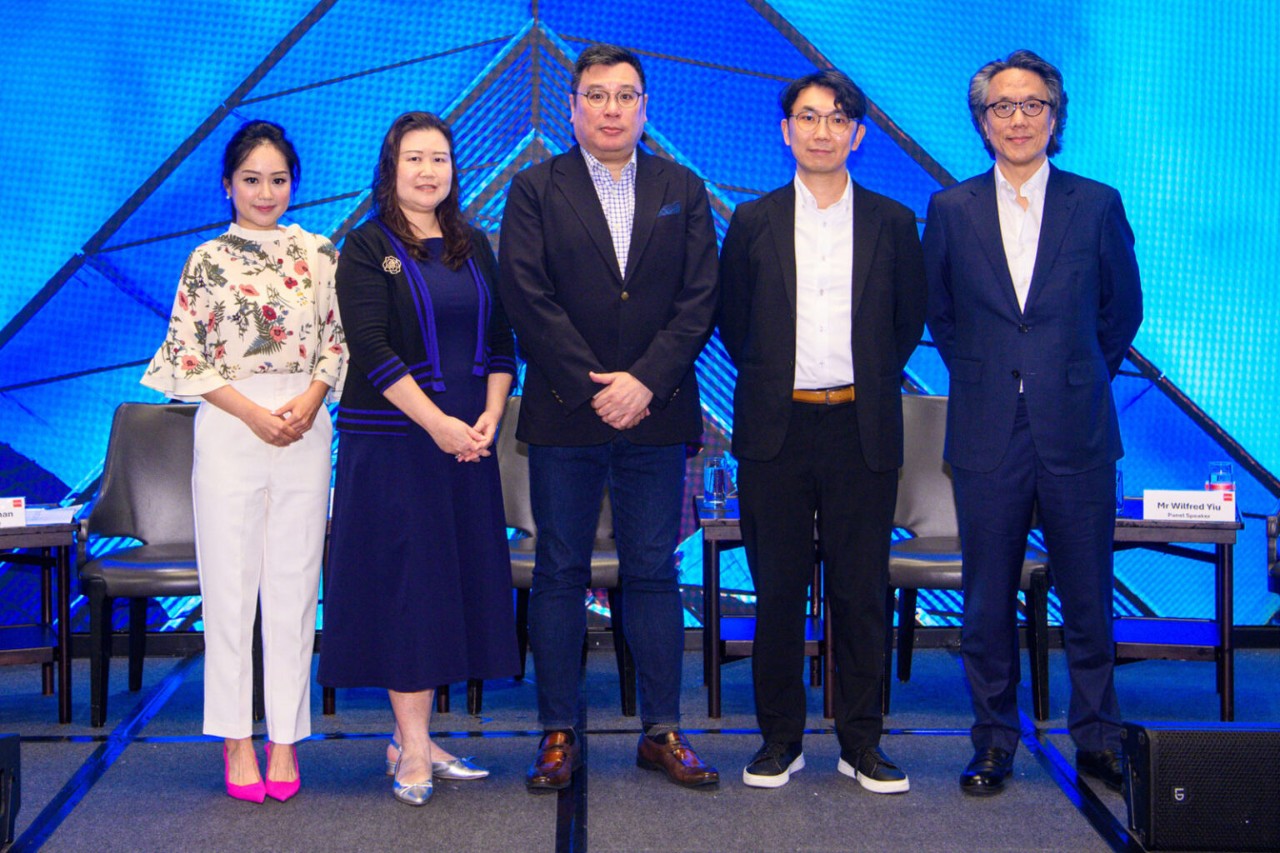
Cindy Chan, head of public affairs at SmartMore, said that Hong Kong SAR needs to move beyond acknowledging these policy signals and actively align with them. She cited the launch of the CUHK No. 1 satellite, which integrates high-resolution remote sensing with AI, from off the coast of Guangdong in February.
‘It’s running in orbit right now and can source a vast amount of targeted data for humanitarian relief during natural disasters,’ Chan said. ‘It shows what’s possible when Hong Kong’s research strengths combine with mainland China’s infrastructure and scale. That’s the kind of collaboration we should be replicating across sectors.’
But Chan stressed that innovation must remain people-centred. ‘When we set the direction for industrial AI, we need to be people-oriented. We keep humans in control of the technology and emphasise the humanistic spirit, because there’s a general fear of machines taking over our jobs.’
She also pushed back against the assumption that the government should lead every effort. ‘Hong Kong is a free economy. The responsibility for driving innovation shouldn’t fall on the government alone.’
Jim echoed that sentiment. ‘The government can help by providing funding and incentives, but we need people from the private sector to drive innovation too. Just look at trailblazers like Elon Musk. The ball isn’t entirely in the government’s court.’
Closing the startup life-cycle gap
Chris Shum, co-founder and CEO of AI startup Asiabots, brought an entrepreneur’s perspective. ‘Technology never stands alone,’ he said. ‘It needs capital investment at each stage – research and development, product deployment, commercialisation.’
While Hong Kong SAR’s incubation infrastructure, including Cyberport and the Hong Kong Science Park, provides early-stage support, Shum sees a gap in the middle of the journey. ‘There’s room to further shorten the product path to market fit,’ he said.
‘With AI, we need to think about both cutting costs and generating revenue’
He also drew a sharp contrast with Silicon Valley. ‘In Silicon Valley, even when a startup is at day zero, investors can already envision the day it gets listed – the ecosystem is that mature. Hong Kong should strive to build that.’
For Shum, the AI conversation needs to stay commercial as well as aspirational. ‘When we talk about AI, we need to think about both cutting costs and generating revenue.’
The talent equation
All four panellists identified talent as one of the most pressing constraints on Hong Kong SAR’s growth agenda. KPMG’s Hong Kong Employment Outlook 2026 found that only 19% of firms forecast headcount growth this year, the weakest reading since 2020. But demand is intensifying in specific areas, with AI deployment tripling to 24% of organisations, and 47% now ranking AI literacy as a priority skill, up from 20% a year earlier. Businesses are concentrating hiring on revenue-driving roles while cutting operations and support functions.
‘Innovators, investors and professionals must all collaborate, from lab to listing’
Hong Kong SAR’s talent admission schemes have already drawn more than 270,000 professionals, with over 100,000 arriving through the Top Talent Pass Scheme. But attracting people solves only part of the problem. Shum argued that Hong Kong SAR must build an ecosystem where innovators, investors and professionals collaborate across the full life cycle of ideas, from lab to listing.
Yiu pushed the point further, warning that Hong Kong SAR cannot afford to draw from familiar sources alone. ‘Hong Kong needs talent from around the world, from diverse backgrounds, to drive innovation and avoid groupthink,’ he argued. ‘Ultimately, we need to dream bigger – not just think about short-term gains but long-term growth.’
More information
Register to access the on-demand ACCA Hong Kong Annual Conference 2026


