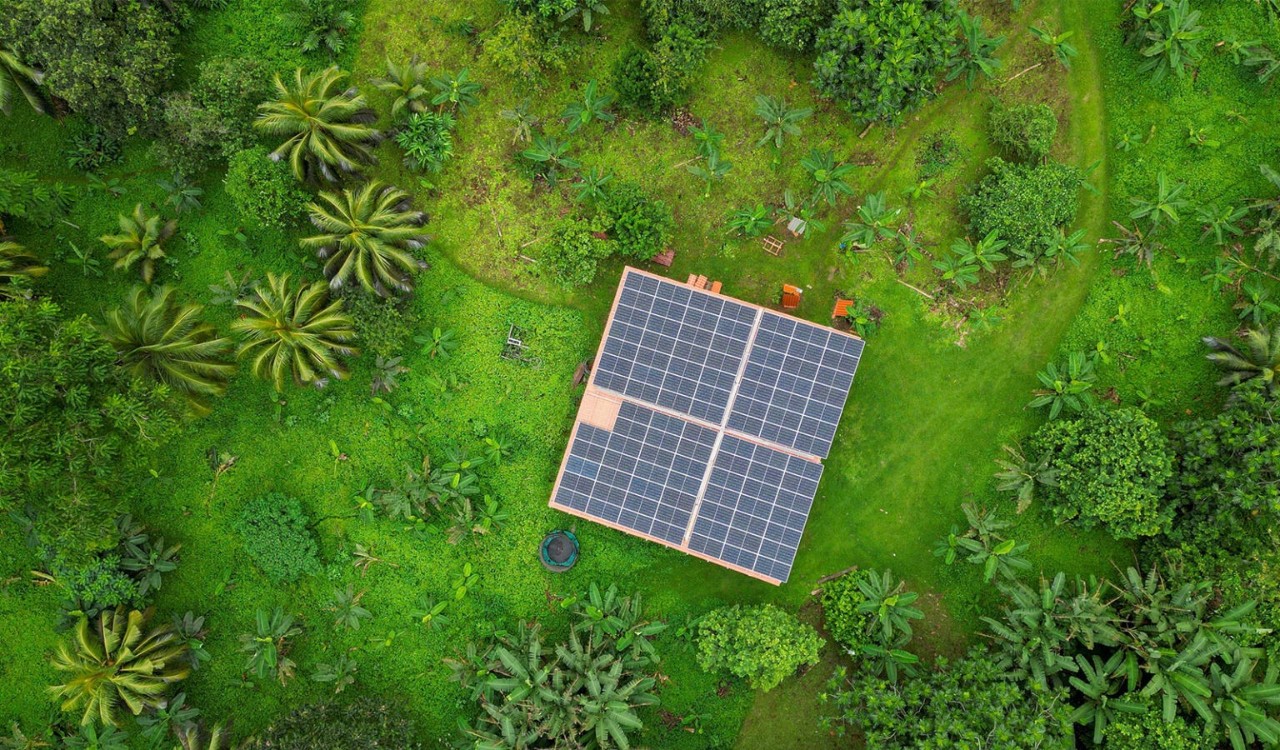
To say that solar is growing across the African continent is to drastically understate adoption of the technology over the past few years.
According to energy thinktank Ember, 2026 will be the third record year for solar installations in a row. In a report published in August, it concluded that Africa was on course to install 17GW of solar in 2026, with deployments up 45% year on year.
‘We have seen a bottom-up revolution happening,’ says Joel Nana, one of the report’s authors and research director of African Tech Futures Lab.
‘Solar is now a viable option you can build in situ’
He points to a confluence of factors that have stimulated the adoption of solar in recent years: the falling cost of photovoltaic panels, the unreliability of mains electricity, the surge in national energy crises and the rising cost of diesel for generators. And, of course, there is the fact that much of Africa sees plenty of reliable sunshine.
Jayne Mammatt is ESG, sustainability and climate change partner at Deloitte in South Africa. She says the proliferation of solar in Africa has different drivers than in the global north. ‘A lot of countries don’t have big networks or a regular supply of electricity, and solar has got to the point that it’s a viable option you can build in situ,’ she says.
Data dearth
Given the pace of solar’s adoption across Africa, it is perhaps unsurprising that the picture in terms of data and records of installations is patchy at best. ‘In most parts of Africa, the process that allows you to get installation permission and therefore be registered on a database is lacking,’ Nana says. ‘What happens instead is that someone has the capital and finds an installer, and they come and put the system in. The utility company isn’t aware of that, so there’s no visibility and no record.’
Small-scale installations account for 75% of Africa’s solar growth
One of his research outputs with Ember is the calculation of a number that gives some sense of the scale of distributed solar adoption on the continent. It turns out that 75% of Africa’s solar growth between 2023 and 2025 most likely comes from distributed solar (ie small-scale systems that generate electricity at or near the point of consumption) – a trend that is largely missed by official statistics.
That said, methods are emerging to improve monitoring. Joshua Dippenaar, who oversees new markets for large independent renewable energy producer Mulilo in South Africa, says: ‘South Africa has developed fantastic ways of quantifying the amount of solar connected to the grid using satellite images, aerial photographs and ways of monitoring the power on the grid,’ he explains. ‘On a sunny day, power consumption goes down much more than on a cloudy day, and you can attribute that to solar power supplying people’s loads, and from that you can estimate the amount of solar on the grid.’
Involvement
Accountants have a wide range of ways to be involved in solar’s adoption in Africa. First, Mammatt says, there are the more traditional methods, such as feasibility studies, business continuity, reporting, auditing and verification.
‘From a Big Four perspective, we get involved with the larger corporates in terms of feasibility and conducting cost-benefit analysis,’ she explains. ‘Parts of our teams will work on corporate transactions, helping with bond issues, green financing and sustainable financing, which support some of the big investments. Also, we’d get involved in the reporting of this information through their annual reports, and of course the auditing and verification of it.’
‘We’re seeing the emergence of asset-backed securitisation’
Also emerging is a huge swathe of business models in which accountants play a similarly crucial role, according to EY-Parthenon’s Africa leader Quintin Hobbs. While distributed solar tends to entail smaller capital investments, which are self-financed or involve bank loans, he says his firm has seen ‘innovative financial solutions both from banks and non-bank institutions’. He identifies the following five as active in the market:
- Solar as a service (SaaS). A third party owns the photovoltaic system, financing, operating and maintaining it. Customers pay monthly fees under long-term contracts.
- Power purchase agreement. This is a long-term contract between a power provider and a customer which involves the provider building, financing, owning and operating the solar panels, while the customer buys the electricity output or a set capacity at a pre-agreed tariff.
- Leasing. Customers lease the solar installation over a defined period.
- Pay-as-you-go solar. This solution is typically used by rural households, with the customer paying daily, weekly or monthly, often using mobile money.
- Mini-grid financing. A remote village or town will put up a solar grid with batteries, often funding the capex through development finance institutions and blended finance.
‘We’re seeing the emergence of asset-backed securitisation,’ Hobbs says. ‘You have thousands of rooftop solar systems pooled by a bank or non-bank institution as an asset class, and they’re sold to investors, typically pension funds or other long-term investors.
‘That enables access to finance, because the providers can recycle capital into new lending. For us, most of the work we do is not in the project development, but where businesses are operating in that ecosystem.’
Capital raising
Hobbs adds: ‘We are seeing a lot of consolidation of these businesses, because it is a new industry and very fragmented. In my space, we work on some of that corporate finance and mergers and acquisitions. A lot of private equity investors are interested in this space, so that’s where a lot of our work occurs now.’
That means an end-to-end service for transactions from valuation, due diligence and deal advisory work to the post-merger integration of people, systems and processes.
‘The room for electricity consumption to grow in Africa is vast’
As these consolidations progress, some solar financing businesses are reaching a scale where they are appearing on the Big Four’s audit radar. ‘They’re getting there,’ Hobbs acknowledges. ‘We’re certainly seeing them now where they’re at a scale where they want EY or another Big Four firm auditing them.’
As for scope for further development, the ‘opportunity is huge’, says Dippenaar. ‘Between 10% and 20% of homes in Africa are electrified,’ he says. ‘The room to grow in Africa in terms of electricity consumption, connecting homes and businesses – and leapfrogged through solar and batteries – is vast. We are so far from the peak, it’s staggering.’


