
As CFO of FINCA Uganda, Robinah Siima FCCA is helping to combat financial exclusion in her country – where overall formal financial inclusion has risen to 68%, heavily driven by digital wallet platforms. However, traditional commercial banking penetration remains low, with only 14% of Ugandan adults holding institutional accounts. ‘We have a significant population that is underbanked,’ she says, ‘and a good number of Ugandans, especially women and young people, do not have formal access to credit facilities.’
FINCA Uganda MDI is a licensed microfinance deposit-taking institution (MDI) regulated by the Bank of Uganda that provides accessible and affordable financial services – including business and agricultural loans, savings and fixed deposit-taking accounts, foreign exchange services, and digital money transfers – to unbanked and underbanked populations who might not otherwise secure traditional banking access, with the vast majority of clients being micro, small, and medium entrepreneurs. It is part of FINCA Impact Finance, a global network of microfinance institutions and banks managed under the financial services arm of FINCA International, a global non-profit organisation.
‘Being an ACCA member is like the constant fuel in my career vehicle’
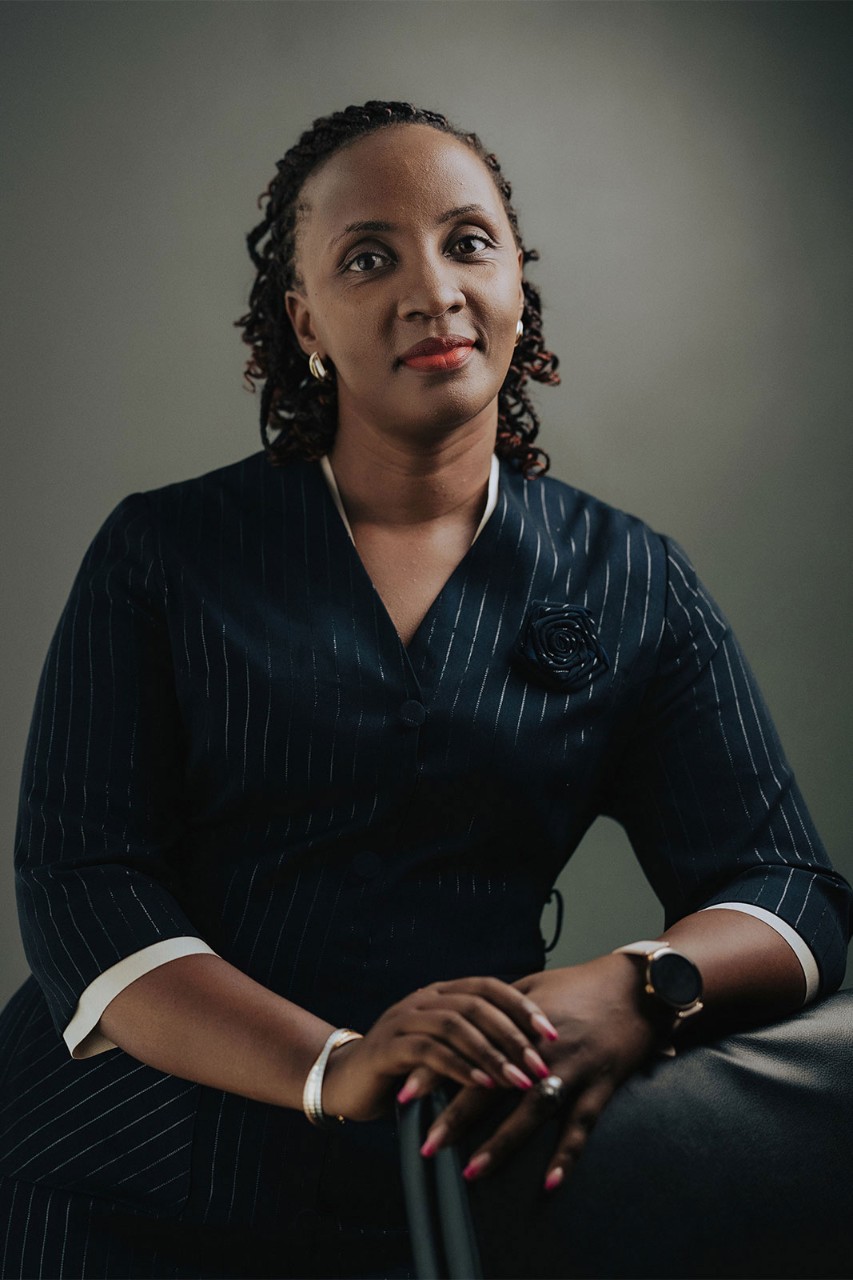
‘An impact-based lender’ is how Siima describes FINCA Uganda’s business model. ‘We want to lend to customers who will use the money, benefit from it and be sustainable.’
Business mindset
Siima’s customer-focused mindset comes from a lifetime of being involved with business. Her parents had an enterprise importing electronic products and she helped calculate their profit margins from an early age. While maths was not her best subject at school, her desire to support her family led to her studying for a bachelor of commerce degree, specialising in accounting, at Makerere University Business School. ‘I knew I wanted to do finance,’ she says. ‘For me, that roadmap was clear from a very young age.’
After graduating with first-class honours, Siima joined Citibank as a trainee, but subsequently moved to EY to become an auditor, believing the role would offer exposure to different sectors and provide a better basis for a career in accounting and finance. At EY, she began studying for the ACCA qualification – which she completed while juggling her studies with work and having three children.
Siima values her ACCA membership for the continuous learning it provides and the opportunity to apply that learning to her day job. She lauds the networking opportunities it also opens up. Being an ACCA member, she says, ‘is like the constant fuel in my career vehicle. I can’t do without it.’
CV
2022
CFO, Finca Uganda
2021
Management accountant/senior management accountant, Electricity Regulatory Authority, Uganda
2016
Financial accountant/management accountant, Finca Uganda
2011
Auditor, EY Uganda
In 2016 came the call that was to change Siima’s career trajectory, when FINCA Uganda invited her to join the organisation as a financial accountant. Keen to learn more about how businesses operate, she jumped at the opportunity. She made an immediate impression by redefining processes so the finance function could report faster and more effectively. Her boss subsequently moved her into a management accountant role, where she had a similar impact.
Siima prides herself on being very intentional about her career journey. So, when it seemed she could not progress any further internally within FINCA Uganda, she moved to the Electricity Regulatory Authority. But FINCA Uganda soon headhunted her back, inviting her to lead the finance function after its CFO left.
Customers first
Siima’s lean finance team of nine (including her) drives FINCA Uganda’s overarching financial strategy by executing five critical functions: financial reporting and statutory compliance; treasury operations and liquidity management; foreign exchange services; risk management; and business intelligence advisory. Treasury sits within the finance function, charged with ensuring that the business has sufficient liquidity to make loans to customers as well as scale its own business operations.
More than half of FINCA Uganda’s customers are female and around 62% of its lending goes to women, youth and entrepreneurial individuals aged between 18 and 45. Their business ventures typically span produce supply chains, agribusiness value addition, retail trade, wholesale commerce, apparel boutiques,and transport services. As well as serving customers in more than 30 physical branches, the organisation provides liquidity to more than 40,000 mobile banking agents (typically shops and kiosks that convert physical cash into digital money and vice versa).
‘I had a lot of very genuine conversations about how to run my first 100 days’
Making sure customer needs are at the heart of organisational decision-making is one of Siima’s main priorities. ‘I focus on managing our costs of funding and costs of operations,’ she explains, ‘so that we have low costs and can get affordable financing to our customers.’ She makes a point of being involved at the start of the product development process to be certain that new products ‘are actually serving the needs of the customer and are going to be affordable to them’.
Stepping up
Initially, Siima had concerns about stepping into the CFO role. Not only was she young – just 32 years old – she was also the first female head of finance that FINCA Uganda had ever appointed. To overcome her fears, she learned from other finance leaders at events hosted by ACCA and other professional bodies. ‘I had a lot of very genuine conversations about how to run my first 100 days and how to create impact,’ she recalls.
Siima decided to use those first 100 days to really get to know her finance team. ‘I engaged with each of them to understand where they thought they were, where they thought they needed to be, how I could support them and how they could support me,’ she explains. She also asked the executive team to define what a successful CFO looked like to them and undertook a review of processes, which resulted in her empowering branches to handle more of their own transactions. ‘That gave me room to execute on strategy with my team without being overloaded with manual or unnecessary assignments,’ she recalls.
‘I like being part of a team that creates impact’
Earlier this year, Siima was named Young CFO of the Year at the ACCA Africa CFO Awards. ‘For me, the award meant an appreciation of my input and my intentionality in accelerating my career,’ she reflects. The process of competing for the award also changed how she thinks and acts as a CFO. She’s since focused on repositioning her team to make it more of an advisory function, rather than just having a traditional reporting remit.
While she’s been establishing herself as a finance leader, Siima has continued to hone the business acumen she first began to develop as a child. To better understand the challenges facing FINCA Uganda’s customers, she has founded three businesses based in Kampala: a coffee processing and exporting company that she owns with her brother, an electronics store for home gadgets and a roadside food court. While she doesn’t run the daily operations of any of the businesses, she keeps a keen eye on their performance, regularly reviewing their sales reports. She also sits on the board of a Ugandan asset management company and chairs the parent-teacher association of Muhika International School.
Balancing all these different responsibilities with a demanding leadership job is challenging, but Siima sees agility as one of her character strengths. She also enjoys taking decisions that make a positive difference to people’s lives. ‘I like challenges,’ she says. ‘I also like being part of a team that creates impact.’


