Modern sport is overflowing with millionaires. And they’re not just the athletes – also minted are some of the mathematicians and data scientists working behind the scenes.
Over the past 30 years, sports analytics has grown into a multibillion-dollar industry, analysing everything from player movements to team tactics. Teams use this data to gain a competitive edge, broadcasters use it to enhance the spectator experience, and governing bodies use it to make competitions fairer (if not always successfully, as victims of dubious VAR decisions will know).
The 400m sweet spot is one of the middle lanes, isn’t it? Well, no
One by-product of all this mathematical analysis is that it has debunked some long-held sporting myths.
Here are some of my favourite examples.
The middle lane
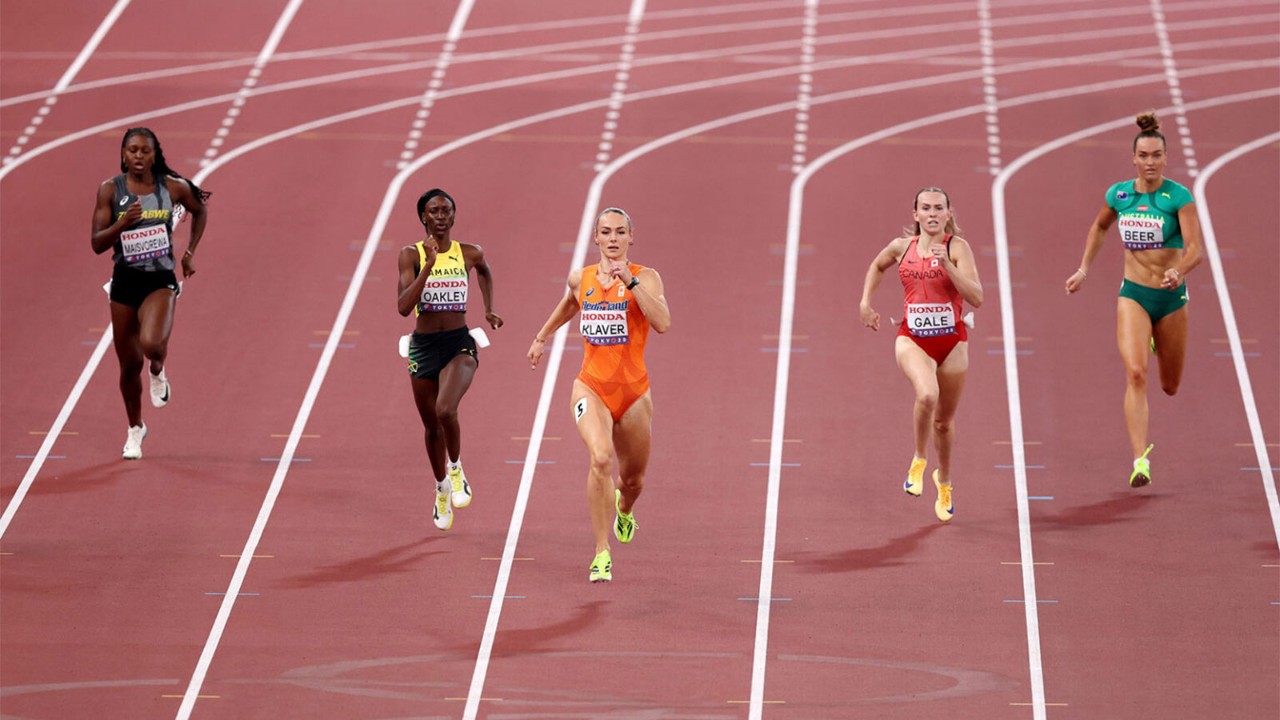
Imagine you’ve made it to the Olympics 400 metres final. Which lane would you choose?
The inside lane means you can see all your competitors ahead of you, but forces you onto the tightest bend, so you have to lean in hard to counter the centrifugal force. The outside lane offers a gentler curve but leaves you running blind, unable to judge your pace against the field. The sweet spot is surely the middle lanes, and that seems to be borne out by the results: Olympic medallists usually emerge from lanes 3 to 6.
For decades this was taken as proof that the middle lanes confer an advantage. But in 2022 the economist David Munro decided to test this assumption.
After studying hundreds of 400m races he concluded there was no statistical benefit to running in a middle lane. In fact, he found that, if anything, the outer lanes were more advantageous. The reason why middle-lane runners tend to win is simple: they earned those lanes by running the fastest times in the heats. The myth was the result of selection bias.
The fairest possible penalty-taking system is the Thue-Morse sequence
Penalty shootouts
Football also has its own popular wisdom. In a penalty shootout, the team that wins the coin toss almost always chooses to take the first penalty. Why? Score first and you apply pressure; miss first and your opponent still feels the burden of taking the kick that would give them the lead.
The belief in first-kick advantage became so widespread that UEFA introduced a new shootout format for the 2017/18 season to counter the perceived unfairness. Instead of alternating A-B-A-B, they trialled an ABBA system: A-B, then B-A, then A-B and so on, meaning that the teams shared the pressure of playing catch-up.
But even ABBA wasn’t perfectly fair. Although the advantage switched, team B would never get more first goes than team A.
Mathematicians pointed out that the fairest possible system is the Thue-Morse sequence, a pattern that begins ABBA, then flips to BAAB, then flips again over longer and longer blocks. It’s beautifully balanced, but rather complicated for fans to follow. In fact, even the basic ABBA format proved too confusing for many. After that single season, UEFA abandoned the experiment.
Then in 2024 came a further twist. A team of mathematicians analysed over 7,000 shootouts and concluded that statistically there is no advantage in going first anyway.
The smart move is to work on other skills instead
Anyone for tennis?
Tennis players also believe in the psychological advantage of going first. If you’re 5-4 down in a set and serving to stay in the match, it’s natural to feel extra pressure. Statistics do reveal a slight advantage to serving first, yet some of the greatest players, including Djokovic and Nadal, often chose to receive first, hoping to apply early pressure.
Just how important is the serve itself, compared to other facets of your game?
Imagine three tennis players:
- The first serves unreturnable bullets every time, winning every point. They will win every game that they serve.
- The second is inept and loses every service point. They will lose every service game.
- The third is a very average player (I’m thinking of myself here). For them, serving is a bit like flipping a coin: they have a 50% chance of winning their service points, and hence 50% of their games.
There seems to be a simple linear relationship here: improve your serve by 10% and you’ll improve your chance of winning a game by the same amount. The maths, though, says otherwise.
Simulations reveal that if on average you win 80% of your service points, your chance of winning the service game is about 98%, almost guaranteed, as the diagram above shows. It means that once a player is highly proficient at serving, any further improvements will yield minimal returns, and the smart move is to work on other skills instead, such as volleying or returning.
Nobody likes to have their pet myths busted. But sometimes going against the wisdom of the crowd pays off. Literally.
More information
If you get a kick out of these numbers, find out about ACCA’s certificate in data analytics


